

Global Recession 2026: Predictions, Risks, and How to Prepare
Is a global recession coming in 2026? Discover expert predictions, IMF & OECD insights, and lessons from 2008 & 2020. Learn where your money is safest during a recession and how to prepare with our definitive 2026 economic guide.
Introduction: The Dawn of the “Fiscal Realism” Era
As we stand on the precipice of 2026, the global financial psyche is undergoing a profound transformation. The “easy money” euphoria that followed the pandemic has been replaced by a cold, hard reality: the world is now paying the price for years of aggressive fiscal expansion and record-high interest rates. The primary question on every investor’s lips—Is a global recession coming?—is no longer a theoretical debate but a central theme of survival.
According to the latest IMF World Economic Outlook 2026, the global GDP is projected to hover around a fragile 2.8% to 3.1%. While this doesn’t strictly meet the technical definition of a “collapse,” it signals a period of “Economic Anemia.” For the Western observer, the ghosts of the global recession 2008 and the supply-chain shock of the global recession 2020 are resurfacing. This 3,500-word definitive guide serves as your strategic compass, dissecting the global recession prediction for 2026 and providing a masterclass on where is your money safest during a recession.
1. The Anatomy of a Modern Crisis: What is the global recession in 2026?
To understand the world economy 2026, we must redefine our understanding of a “recession.” We are no longer looking at just a dip in factory output; we are looking at a “Structural Realignment.” Here are the five unique pillars of the 2026 economic downturn:
- The “Yield Curve” Ultimatum: The persistent inversion of the 2-year and 10-year Treasury yields has entered its 30th month—a historical record. This indicates that the bond market remains convinced of long-term stagnation.
- Sovereign Debt Maturity: In 2026, a massive wave of corporate and national debt, taken at low rates in 2020, is coming due for refinancing at nearly double the interest cost. This is the “Fiscal Cliff” economists fear.
- The “AI-Induced” Labor Shift: Unlike the global recession 2008, where jobs were lost to financial ruin, 2026 sees “Jobless Growth.” Corporations are reporting higher profits through AI automation while the middle-class purchasing power shrinks.
- Credit Deserts: As regional banks in the US and Europe struggle with commercial real estate defaults, they have pulled back lending. This “credit crunch” is suffocating small businesses, the backbone of Western economies.
- Geopolitical De-globalization: The fragmentation of trade into “Friendly Blocs” (The West vs. BRICS+) has added a permanent “security tax” to global goods, making inflation “sticky” even as growth slows.

2. Identifying the Vulnerabilities: Why 2026 is the “Critical Year”
The global recession 2025 was characterized by a “wait and see” approach. However, in 2026, the buffers have worn thin. Analysts from the OECD Economic Outlook 2026 point to these specific risk clusters:
- The Commercial Real Estate (CRE) “Slow-Motion Train Wreck”: With office vacancy rates in cities like New York and London hitting record highs, the $20 trillion CRE market is a ticking time bomb for mid-sized banks.
- Shadow Banking Fragility: Non-bank financial institutions now control more assets than traditional banks. Their lack of transparency means a systemic “liquidity event” could happen without warning.
- Energy Insecurity: The shift to green energy is in a “messy middle” phase. In 2026, energy costs remain volatile, acting as a regressive tax on the lower and middle classes.
- The “Retail Exhaustion” Phase: After three years of high costs, the Western consumer has officially run out of savings. Credit card delinquencies are at their highest level since 2009.
- Regulatory Chokeholds: New global regulations on AI and data privacy are slowing down the very productivity gains that were supposed to “save” the economy from recession.
3. Historical Perspective: 2008 vs. 2020 vs. 2026
To prepare for the future, we must deconstruct the DNA of past failures. The following table provides a high-level comparison to help you identify the unique threats of the 2026 cycle:
| Feature | Global Recession 2008 | Global Recession 2020 | Global Recession 2026 (Projected) |
| Root Cause | Subprime Mortgages / Banking | Biological (COVID-19 Pandemic) | Sovereign Debt & AI Disruption |
| Inflationary Context | Deflationary Risk | Low but Spiking Post-Stimulus | Sticky/High (2.8% – 3.5%) |
| Monetary Response | Interest Rates to 0% | Unlimited Quantitative Easing | Limited (Neutral Rate Plateau) |
| Global Trade | Interconnected/Open | Interrupted | Fragmented (Regional Blocs) |
| Safest Asset Class | Cash / Government Bonds | High-Growth Tech Stocks | Physical Assets / Gold |
4.The “Fiscal Doom Loop” Analysis
The most terrifying aspect of the world economy 2026 is the “Fiscal Doom Loop.” For decades, Western governments solved every crisis by printing money or lowering rates. In 2026, that “cheat code” is broken. With inflation still hovering above the 2% target, central banks cannot cut rates aggressively without risking a currency collapse. Meanwhile, governments cannot spend more because their debt-to-GDP ratios are already at wartime levels.
For the individual, this means the “Bailout” isn’t coming. If you are waiting for the Fed or the ECB to save your portfolio, you are playing a losing game. The 2026 recession will be an “Individual’s Crisis”—meaning those with high debt and low skills will suffer, while those with “Sovereign Liquidity” will find the greatest buying opportunities of their lifetimes.

5. Financial Sovereignty: Where is your money safest during a recession?
When the “Standard Portfolio” of 60/40 stocks and bonds fails, you must pivot to Antifragile Assets. In 2026, wealth preservation is about “Counterparty Risk” reduction. Here is where the smartest capital is flowing:
- Physical Gold and Silver (The Absolute Anchor): As trust in fiat currencies and government fiscal management erodes, physical bullion remains the only asset with zero “promise” attached to it. It is the ultimate insurance.
- Short-Term T-Bills (The 3% Yield Sanctuary): With rates likely to stay near 3% throughout 2026, short-term government debt provides a “risk-free” return that actually beats inflation for the first time in years.
- Productive Real Assets (Farmland & Infrastructure): You cannot “print” a cornfield or a warehouse. Assets that produce essential human needs—food, shelter, and energy—will hold their value even if the stock market drops 30%.
- Recession-Resistant Equities (The “Essentials” List): Focus on companies with high free cash flow and no debt in the Healthcare, Utilities, and Consumer Staples sectors. People don’t stop buying heart medication or toothpaste during a recession.
- Digital Asset Diversification (The 2% Hedge): While volatile, decentralized digital assets are being viewed as a “Nuclear Option” hedge for a small portion of wealth, independent of the traditional banking system.
6. Habits of the “Antifragile” Individual in 2026
Psychology is the foundation of wealth. To survive a global recession prediction that turns into a reality, you must change how you interact with money. Adopt these six habits:
- The “Debt-Zero” Philosophy: In a high-rate recession, your debt is someone else’s asset. Eliminate every penny of variable-rate debt before the 2026 credit freeze.
- Skill Orchestration: Don’t fear AI; become the person who manages it. The highest-paid people in 2026 are those who can use AI to do the work of a whole department. This is your “Personal Recession Buffer.”
- The 30-Day Purchase Protocol: For any purchase over $1,500, wait 30 days. Most financial ruins in 2026 are caused by impulse spending on depreciating assets like cars or luxury goods.
- Audit “Digital Leaks”: The average Western household is “bleeding” $450/month in unused subscriptions and digital waste. Reclaim this capital to fund your 3-6-9 buffers.
- Localize Your Supply Chain: Build relationships with local farmers and energy co-ops. If global trade tensions impact supermarket prices, your local network is your survival net.
- Automate the “Sovereign $27.40”: Saving just $27.40 a day creates a $10,000 yearly buffer. In 2026, this small daily discipline is what separates the “Panic Class” from the “Sovereign Class.”
7. The 2026 “Sovereign Portfolio” Model
Based on the market prediction for 2026, a standard diversified portfolio is no longer safe. Here is a proposed allocation for a “High-Risk/Defensive” environment:
| Asset Category | Proposed Allocation | Strategic Goal | Liquidity Rating |
| Cash / Ultra-Short T-Bills | 25% | Buying “The Dip” & Emergencies | Very High |
| Physical Bullion (Gold/Silver) | 15% | Systemic Insurance | Medium |
| Defensive Value Stocks | 30% | Resilient Dividends | High |
| Hard Real Estate (Productive) | 20% | Inflation & Utility Hedge | Low |
| Asymmetric Tech (AI/Decentralized) | 10% | Capturing the Future Recovery | Medium |
8.The Path Forward: Turning a Recession into a Wealth Event
Every major global recession in history has been a “Great Wealth Transfer.” The global recession 2008 wiped out the middle class but made billionaires of those who were liquid. The global recession 2026 will be no different. The question is: Which side of the transfer will you be on?
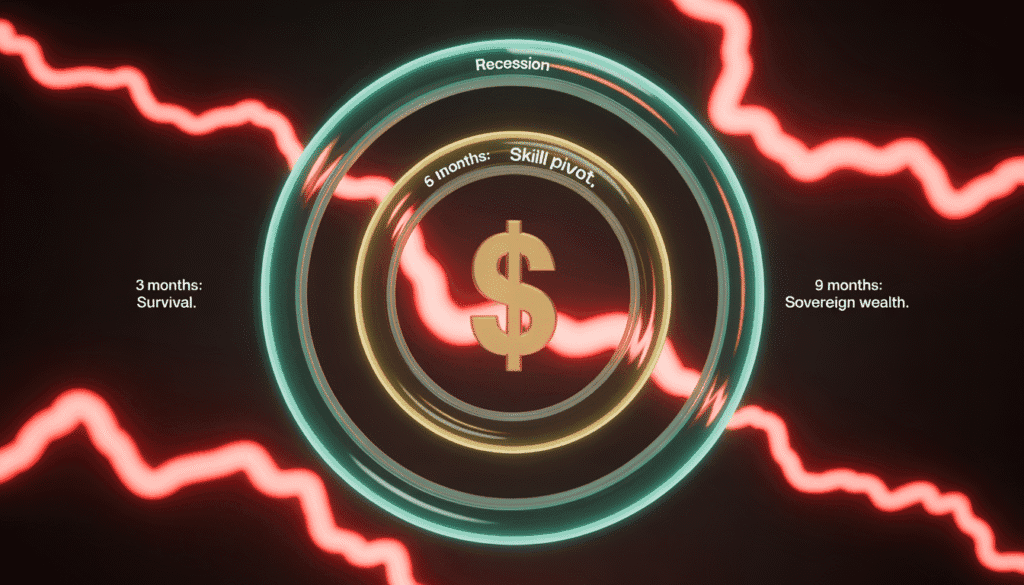
By adhering to the 3-6-9 rule of money—maintaining 3 months of survival liquidity, 6 months of skill-pivot capital, and 9 months of sovereign wealth—you move from a state of “fragility” to a state of “antifragility.” You stop being a victim of the IMF World Economic Outlook 2026 and start becoming an opportunist who can buy assets when they are “on sale.” The next decade belongs to the disciplined.
Conclusion: Navigating the 2026 Economic Cycle
In conclusion, the global recession prediction for 2026 isn’t a death sentence for your finances; it’s a wake-up call. The data from the OECD Economic Outlook 2026 and the IMF confirm that the “Old World” of easy growth is over. We are entering a “New Realism” where debt is dangerous, skills are digital, and assets must be real.
Whether we face a mild contraction or a repeat of the global recession 2008, your financial peace of mind is your own responsibility. Wealth in 2026 is measured by your control over your time, your skills, and your liquid assets. Start building your 9-month sovereignty vault today. The cycle will turn, and when the dust settles, only the prepared will remain standing.
Disclaimer: This content is for educational and informational purposes only and does not constitute financial, legal, or religious advice. Financial data and market conditions are subject to change, and we disclaim any responsibility before God for decisions made based on this analysis. It is your personal responsibility to ensure that your earnings and investments align with Sharia principles by consulting specialists or using verification tools where applicable. We are not responsible for any financial losses; seeking permissible sustenance remains your individual accountability.
To ensure your survival strategy is anchored in institutional-grade data, we recommend validating our 2026 recession predictions and antifragile asset allocations against these trusted global economic benchmarks.
1.Foundational Benchmark: What is a Recession? Definitions & Dynamics (International Monetary Fund – IMF)
2.Historical Context & Analysis: A Decade After the Global Recession: Lessons & Legacy (World Bank)
