
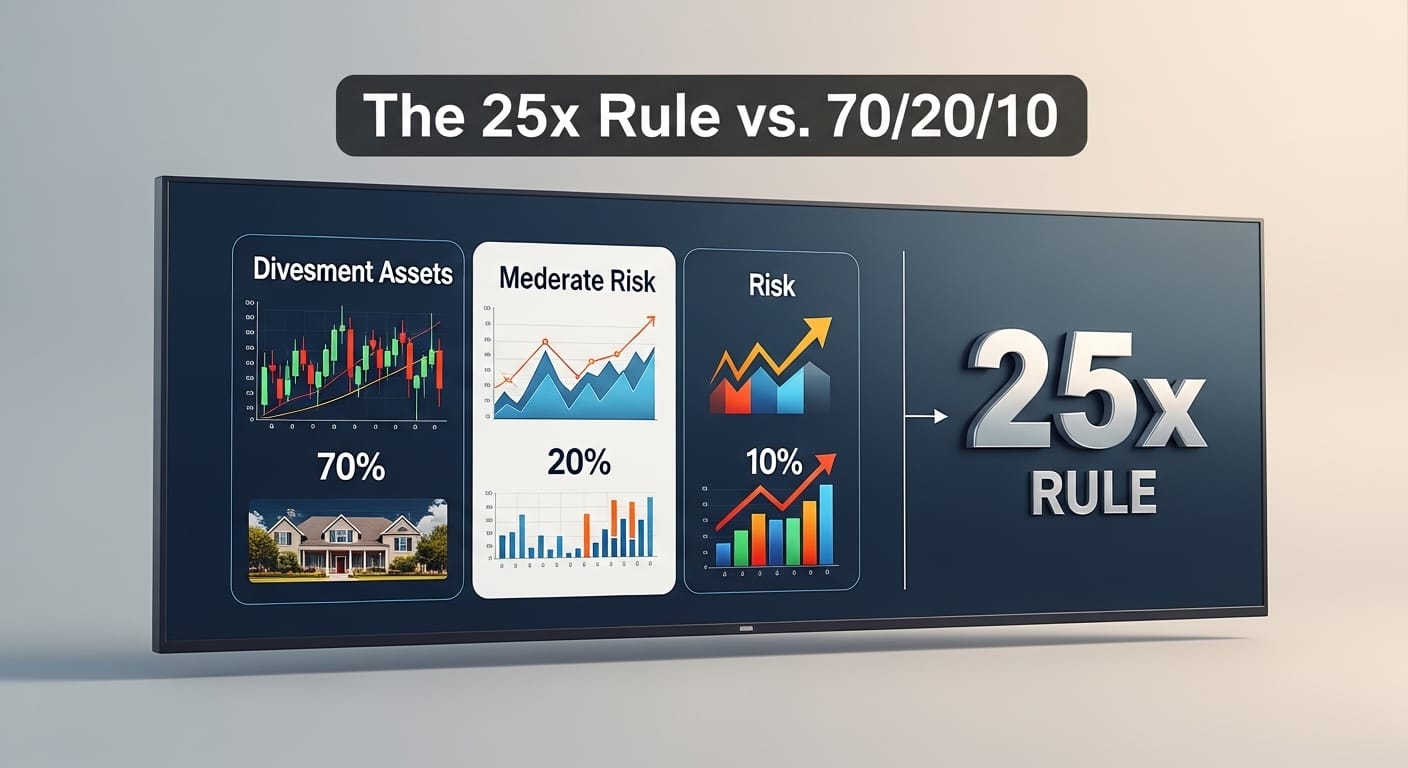
Master Your Money: The 25x Rule vs. 70/20/10 – Which is Best for 2026?
Master your money in 2026 with the ultimate guide to the 25x rule and 70/20/10 budget strategy. Learn how to combat 3.4% service inflation, calculate your FIRE number, and build USD wealth using AI investment tools today.
Introduction: Why Your 2024 Financial Logic is Failing (March 12, 2026)
If you are still clutching 2024 financial logic on this Thursday, March 12, 2026, you are essentially watching your purchasing power dissolve in real-time. The European market has hit a structural wall. While headline inflation looks “stable” on paper at 1.9%, the “Service Inflation” has just clocked in at a stubborn 3.4% across the Eurozone this month. For any professional managing a USD portfolio while navigating Western markets, the “middle-class squeeze” is a daily reality, not a theory. To figure out how to make 2026 a successful year?, you need a system that works like a defensive shield. We are pitting the aspirational 25x rule against the practical 70/20/10 rule money management strategy to see what actually survives this recalibrated economy.
Table of Contents
I: 6 Practical Steps to Audit Expenses and Secure Your 2026 Wealth
- Audit your total annual expenses in USD, but ignore historical averages. Look at the 13% surge in energy and service costs in high-cost hubs like London or Berlin over the last 6 months.
- To truly understand how to calculate your FIRE number in 2026, take your revised annual spending and multiply it by 25—then add a 15% “Recession Buffer” to stay safe against the current financial prediction for 2026.
- Identify “Dead Capital”—any funds sitting in low-yield European savings accounts—and migrate them immediately to USD benchmarks yielding above 4.8%.
- Set up an automated “Wealth Siphon” that moves 20% of your income into global ETFs the exact second your paycheck clears, before you even see the balance.
- Re-evaluate your tax residency; in 2026, your location is a purely financial decision. Moving your USD assets to high-efficiency jurisdictions is now a survival move.
- Conduct a “Lifestyle Stress Test” every quarter to ensure your fixed costs haven’t bloated beyond the 70% threshold.

II: Resilience Strategies: Shielding Your Portfolio from High Inflation
- Aggressively move liquid reserves into USD high-yield money market funds to neutralize the eroding effects of budgeting for high inflation in 2026.
- Deploy AI investment tools for 2026 wealth building to hunt for “Arbitrage” in your recurring costs, specifically in insurance and energy where rates fluctuate weekly.
- Adopt “Forward-Purchasing” for non-perishable goods to lock in March 2026 prices before the late-year supply chain adjustments hit the shelves.
- Prioritize repairable, high-quality durable goods over “fast consumerism”—in 2026, the cost of replacement is a silent wealth-killer.
- Diversify your income by establishing at least two passive income streams for 2026 that pay out in USD to hedge against Euro instability.
- Implement a “Cash-Flow Lockdown” during months where service costs spike more than 5% above the 2026 average.
III (Table 1): 70/20/10 vs 50/30/20 rule: Which is better?
| Feature | The 70/20/10 Rule | The 50/30/20 Rule |
| Housing & Needs | 70% (Handles 2026 EU Rent Spikes) | 50% (A relic of 2019 price levels) |
| Investment Engine | 20% (Aggressively targets the 25x rule) | 20% (Often cannibalized by lifestyle) |
| Upskilling/Buffer | 10% (Critical for AI-Proofing) | 30% (Too much waste in “Wants”) |
| Winner | 70/20/10 vs 50/30/20 rule: Which is better? The 70/20/10 wins. | Dangerous for Western Markets in 2026 |
IV: The Math of Freedom: Combining the 25x Rule with Safe Withdrawals
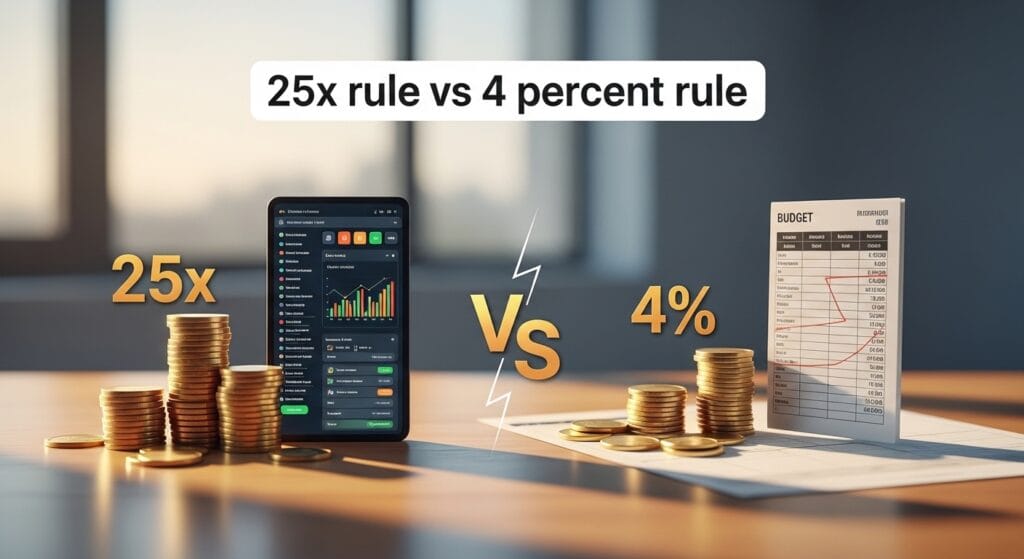
The core of modern independence is mastering the 25x rule vs 4 percent rule explained as a dynamic duo, not a static formula from a textbook. While the 25x rule sets your destination—the total mountain of USD you need—the 4% rule acts as your safe withdrawal speed limit. However, building generational wealth with the 25x rule in 2026 requires a more cautious 3.5% withdrawal rate to handle the “Service Inflation Gap” currently affecting London and Paris. If your principal isn’t in high-growth technology assets, you are essentially losing ground every single day to the rising cost of existence.
V: The 2026 Wealth Vocabulary: New Terms for the AI Economy
- Agentic AI Portfolios: Autonomous systems that manage the what is 70-20-10 budget rule by rebalancing assets based on real-time global sentiment.
- Service Inflation Gap: The delta between headline inflation (1.9%) and the actual cost of human-delivered services (3.4%) in Europe this March.
- Tokenized Asset Yield: Modern passive income streams for 2026 generated from fractional ownership of energy grids and AI data centers.
- The “30x Buffer”: The new ultra-conservative standard for those planning to retire in high-cost cities to ensure zero risk of ruin.
- Inference Mining: A new way to earn USD by renting out your local computing power to global decentralized AI networks.
VI: The 2026 Student Survival Kit: 6 Tactics to Build Wealth on a Budget
- Track every single USD that enters your account—student life in 2026 is too expensive for “guestimate” budgeting.
- Automate a 20% transfer to a low-cost global index fund even if the amount feels trivial; time is your only unfair advantage.
- Allocate your 10% “Growth” bucket for the 70 20 10 rule for students specifically toward “AI Orchestration” certifications.
- Scale your “Essentials” by utilizing co-living and bulk-buying apps—individualism is a luxury students can’t afford in 2026.
- Review your “Daily Burn Rate” every Sunday night to stay ahead of rapid price movements in European campus cities.
- Use student-exclusive AI investment tools for 2026 wealth building to find zero-fee entry points into the USD market.
VII (Table 2): What is the financial prediction for 2026?
| Asset Category | Expected 2026 Yield | Why it’s the Which fund is best for 2026? |
| AI Infrastructure | 12% – 16% | Best assets to buy now for the 25x rule |
| High-Yield USD | 4.8% – 5.1% | Safety harbor for your 20% wealth bucket |
| EU Logistics REITs | 7% – 9% | Driven by the 2026 re-shoring trade boom |
| Digital Utilities | 8% – 10% | Reliable passive income streams for 2026 |
VIII: The Elite Secret: Mastering Income Velocity to Outpace Inflation
One of the most guarded 7 financial secrets to build wealth in 2026 is that “Income Velocity” beats “Income Volume.” The elite don’t just earn; they move USD into their 20% bucket faster than the Euro can lose its value to service hikes. Mastering how to live on 70% of your income creates a “forced margin” that acts as a physical shield during market downturns. In 2026, wealth is built by those who stop “saving” and start “allocating” using the what is 70-20-10 budget rule. By treating your personal finances like a high-growth startup, you outpace the 3.4% inflation currently eroding the middle class.

IX: The 9-Month Cash Moat: Defensive Concepts for a Recession-Proof Life
- The Cash Moat (9 Months): Maintain 9 months of “Must-Pay” expenses in a highly liquid USD account to survive the personal finance strategies for 2026 recession.
- Defensive Rebalancing: Shifting your 20% bucket toward “Anti-Fragile” sectors like healthcare and energy that hold value when the broader market dips.
- Skill Arbitrage: Using the 10% bucket to learn high-demand technical skills that allow you to charge premium rates despite a slow economy.
- Inflation-Linked Bonds: Utilizing 2026-specific TIPS to ensure your 25x rule principal maintains its real purchasing power over time.
X: The 70/20/10 Career Shield: Future-Proofing Your Job in the AI Era
- Commit to the 70/20/10 rule for employee development by spending 70% of your work time on core high-leverage tasks.
- Allocate 20% of your professional time to collaborative innovation with the people building the next wave of 2026 tech.
- Dedicate 10% of your budget to external upskilling, specifically in “AI Orchestration” and advanced data analysis.
- Use AI investment tools for 2026 wealth building to automate your career benchmarking and salary negotiations.
XI (Table 3): Identifying the What is 70-20-10 budget rule?
| Budget Bucket | Allocation | 2026 Strategic Target (USD) |
| Survival & Needs | 70% | Rent, Energy, Logistics, Food |
| Wealth & Growth | 20% | Global ETFs, Retirement, Tech Stocks |
| Edge & Buffer | 10% | Skills, Debt, Giving, Occasional Fun |
XII:AI Financial Intelligence: Automated Tactics to Stop Budget Leakage
Manual budgeting is a losing battle in the current high-speed economy. AI investment tools for 2026 wealth building act as a 24/7 financial analyst, scanning for “leakage” in your 70% bucket. These tools identify which fund is best for 2026? by correlating global USD flows with real-time interest rate shifts. If you want to learn how to live on 70% of your income without feeling the pressure, you must let technology manage the “microwork” of your finances while you focus on the macro-strategy.

XIII: The 2026 Success Roadmap: 5 Urgent Moves for Your Paycheck
- Execute a “Subscription Purge” to reclaim at least $150/month for your 20% bucket.
- Move your emergency fund to a USD account yielding at least 4.8% APY.
- Re-calculate your FIRE number using March 2026 rental data for your specific target city.
- Automate an “Auto-Escalate” on your 20% bucket—increase the transfer by 1% for every month you stay under budget.
- Use your 10% “Edge” money to hire a 2026 financial strategist who understands the personal finance strategies for 2026 recession.
XIV: The 70% Lifestyle: Real-World Habits for Managing Living Costs
- Prioritize “Fixed-Rate” housing to lock in the largest expense of your 70% bucket.
- Use AI-driven price-comparison tools for every major grocery and utility purchase in real-time.
- Adopt the “48-Hour Wait Rule” for all non-essential USD spending in the 70% bucket.
- Batch-buy essentials during Q1 to avoid the 2026 supply chain seasonal price hikes.
- Utilize “Community Arbitrage”—sharing luxury 10% bucket costs (like tech or travel) with a trusted group.
XV (Table 4): The 70-20-10 Rule: 2026 Salary Breakdown (USD)
| Net Monthly Income | 70% (Living) | 20% (Future) | 10% (Growth) |
| $5,000 | $3,500 | $1,000 | $500 |
| $10,000 | $7,000 | $2,000 | $1,000 |
| $18,000 | $12,600 | $3,600 | $1,800 |
XVI: The 2026 Financial Verdict: Why Savers are Losing and Wealth Builders are Winning
The conclusion for March 2026 is absolute: you cannot reach a 25x destination without a 70/20/10 engine. The 70/20/10 rule money management strategy keeps you solvent during budgeting for high inflation in 2026, while the 25x rule gives your discipline a final purpose. The winners this year are those who use their 70% bucket to survive the present and their 20% bucket to buy their future freedom. Stop thinking like a saver and start acting like a systematic wealth builder.
Conclusion: Reclaiming Your Autonomy in the 2026 AI Economy
Mastering your money in 2026 is about more than numbers; it is about reclaiming your time and autonomy. By sticking to the 70/20/10 rule money management strategy, you are ensuring that the 2026 economy doesn’t swallow your dreams. By chasing the 25x rule, you are keeping your eyes on the exit sign of the rat race. The world is changing fast, and the 3.4% services inflation is a real threat, but for those with a rigid system and a clear target, the opportunity for wealth has never been greater.
FAQ: Strategic Financial Questions for 2026
What is the 25x rule for financial independence?
It is having a principal equal to 25 times your annual expenses in a USD portfolio.
Is the 25x rule safe for retirement in 2026?
Yes, though with current services inflation, many now target a 28x or 30x multiplier for extra safety.
What is better than the 50/30/20 rule?
The 70/20/10 rule—it is the only one that reflects the high fixed costs of 2026 Western life.
What are alternatives to the 70-20-10 rule?
Zero-based budgeting or the “Pay Yourself First” 20% investment rule.
What is the 3 6 9 rule of money?
3 months of cash for safety, 6 for security, and 9 for total peace of mind during a recession.
What is the best way to save money in 2026?
Automation—using AI investment tools to find and eliminate “waste” in your 70% bucket.
Is 70/20/10 a good budget?
It is the gold standard for anyone living in a Western market in 2026.
Is 2026 a good time to invest?
Yes—specifically in best assets to buy now for the 25x rule like AI and Energy.
How do I improve my finances in 2026?
Increase your “Knowledge Yield” and stop leaving cash in 0% accounts.
Where should you put your money in 2026?
High-yield USD accounts, Global AI ETFs, and diversified passive income streams.
Disclaimer: This content is for educational and informational purposes only and does not constitute financial, legal, or religious advice. Financial data and market conditions are subject to change, and we disclaim any responsibility before God for decisions made based on this analysis. It is your personal responsibility to ensure that your earnings and investments align with Sharia principles by consulting specialists or using verification tools where applicable. We are not responsible for any financial losses; seeking permissible sustenance remains your individual accountability.
To build a 25x Rule Portfolio that survives 2026 market volatility, we have aligned this guide with the current gold standards of fiscal planning. We strongly recommend cross-referencing your Wealth Siphon and FIRE Number with these verified resources.
1.Financial Independence Roadmap: The 25x Rule for Retirement Explained (The Casual Capitalist)
2.Practical Budgeting Framework: Understanding the 70/20/10 Budget Rule (Albert)
