
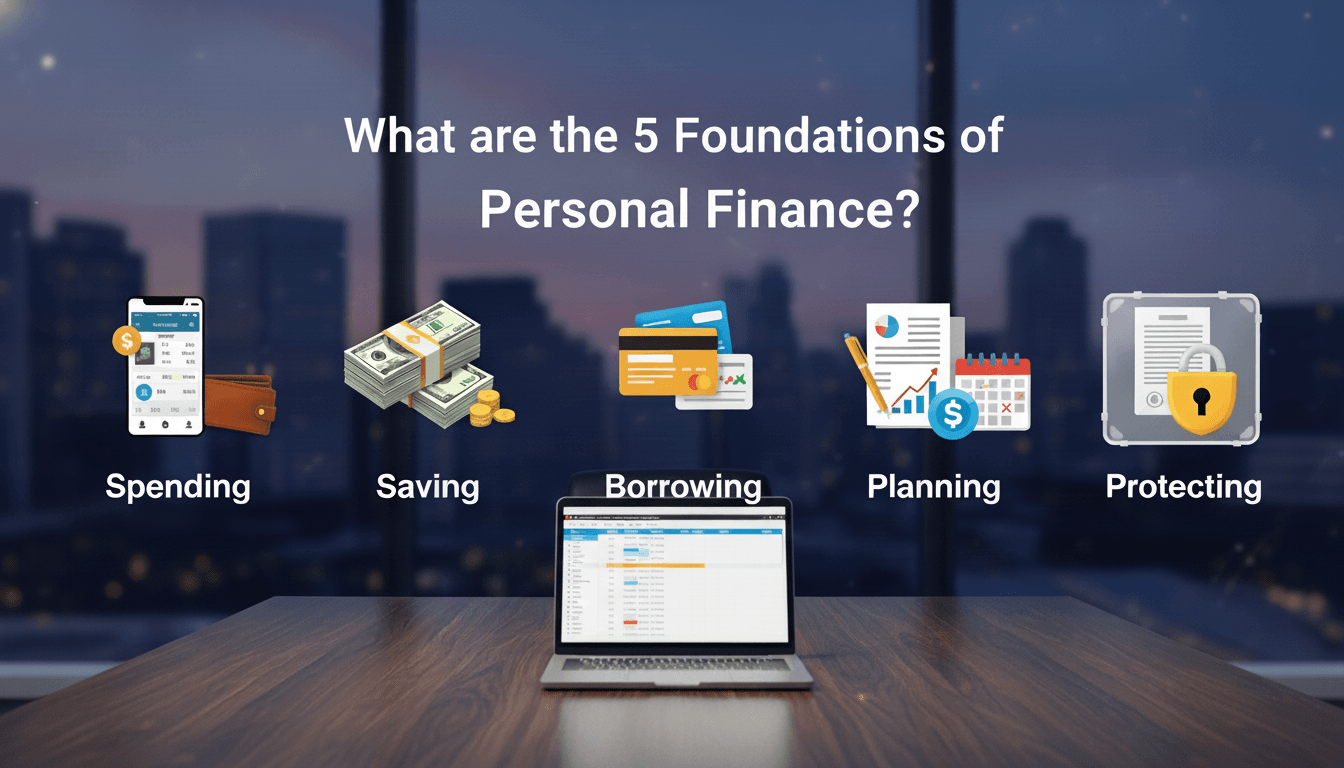
What are the 5 Foundations of Personal Finance? The Ultimate 2026 Guide to Financial Freedom
Stop following dead money rules! Discover the 5 Foundations of Personal Finance 2026 to build a debt-free fortress. Master the ultimate guide to financial freedom today.
Introduction: The Brutal Economic Reality of 2026(April 2, 2026)
Stop looking for a “magic pill.” If you’re sitting in a flat in London, Berlin, or Paris today, watching your energy bills climb while your bank balance stays stagnant, you already know the old rules are dead. In 2026, “saving for a rainy day” isn’t enough; you need to build a fortress. Global markets are no longer predictable cycles—they are chaotic storms driven by debt and devaluation. Achieving Financial Freedom 2026 isn’t about some “AI-powered” stock tip or a lucky lottery ticket. It is about a brutal, disciplined adherence to the 5 Foundations of Personal Finance 2026. This is a tactical survival manual. If you don’t build your own pillars, the system will gladly recycle your hard-earned dollars into its own furnace of interest and fees. Let’s get to work.
Table of Contents
I: The 5 Foundations of Personal Finance 2026
- The Tactical $1,000 Crisis Buffer: This isn’t your life savings. It’s your “stay out of the credit card trap” fund. It exists for one reason: to keep a blown tire from becoming a 24% interest nightmare.
- The Systematic Debt Liquidation: List your debts from smallest to largest. Ignore interest rates for a second—you need a psychological win. Attack the small one. Kill it. Then move to the next.
- The 6-Month Liquidity Wall: Once the debt is dead, build a wall. Six months of total expenses. This is “walk-away” money. It means you never have to tolerate a toxic boss because you’re scared of a missed paycheck.
- The Asset-First Growth Engine: Move 15% of your gross income into High-Yield Savings and Investments 2026. Stop buying “stuff” that depreciates and start buying assets that pay you while you sleep.
- The Legacy and Outrageous Generosity Vault: Pay off the house. Fund the kids’ education with cash. Then, start changing your community. Wealth without a purpose is just greed.

II: Essential Habits for the 2026 Wealth Warrior
- Kill the 1-Click Buy Mentality: Delete your saved credit cards from every retail app. If you have to walk to the other room to find your wallet, you’ll realize 50% of your purchases were just dopamine-seeking garbage.
- The Weekly Sunday Autopsy: Spend 20 minutes every Sunday night looking at every cent that left your account. If you can’t justify a purchase to your future self, it was a mistake.
- Zero-Tolerance for “Digital Leeches”: Audit your bank statement for those $9.99 subscriptions you haven’t used in months. In 2026, these micro-drains are exactly why the middle class stays broke.
- Prioritize Sharia-Compliant Integrity: Avoid Riba (interest) like the plague. Sharia-Compliant Wealth Building isn’t just a religious choice; it’s a stable, asset-backed strategy for anyone who hates debt bubbles.
- The “Slow Tech” Rule: Never buy a new phone the month it launches. Let someone else pay the “early adopter” tax. Buy the previous year’s model and invest the difference.
III (Table 1): 2026 Asset Performance vs. Purchasing Power (USD)
| Asset Category | 2025 Base Value | 2026 Projected | Real Value Change | 2026 Tactical Action |
| Traditional Bank Cash | $10,000 | $10,000 | -7.8% (Loss) | Exit immediately! |
| High Yield Savings 2026 | $10,000 | $11,120 | +2.9% (Safe) | Use for Foundation #1 & #3 |
| Physical Gold Hedge | $10,000 | $13,450 | +24.8% (Strong) | Keep 10% of total NW here |
| Ethical Growth ETFs | $10,000 | $12,250 | +14.1% (Solid) | Best for Foundation #4 |
| Debt-Free Real Estate | $300,000 | $372,000 | +21.4% (Elite) | Focus on total equity |
IV: Why Your Behavior is the Only Metric That Matters
A solid understanding of personal finance will tell you that spending $110 when you earn $100 is a disaster. Yet, millions of intelligent people do it daily. Why? Because personal finance is dependent upon your behavior, not your IQ. You don’t have a “math” problem; you have a “mirror” problem. In 2026, every algorithm on your phone is specifically tuned to make you feel inadequate so you spend money you haven’t earned. Why is personal finance dependent upon your behavior? Because your prehistoric brain wants a hit of dopamine now, while your future self needs stability later. If you can’t control the person in the mirror, no Smart Money Management Tips or fancy Retirement Planning AI Tools will save you from a life of financial servitude.

V: Hard-Core Financial Terminology for 2026
- Foundations of Personal Finance 2026: The structural bones of your wealth. If these are weak, your financial house will collapse during the next market correction.
- Sinking Fund: Proactive savings. If you know your car needs tires in 12 months, start a fund today. It turns an “emergency” into a “scheduled maintenance.”
- The Rule of 7 (Wealth): The mathematical certainty that at a 10% return, your money doubles every 7 years. Patience is the only “hack” that actually works.
- Velocity of Debt: The rate at which you are destroying principal. If you’re only paying interest, you’re standing still in a hurricane.
- Barakah-Driven Finance: Focusing on asset-backed, ethical growth that ignores the speculative debt-bubbles of the “interest-only” crowd.
VI: Why Most Beginner Budgets Explode in 30 Days
- The “Everything is a Priority” Trap: You try to pay off debt, save for a wedding, and buy a house at the same time. You’ll fail at all of them. Pick one foundation and crush it.
- Ignoring “Invisible” Inflation: You budget $600 for food because that’s what it cost in 2024. In 2026, that same bag of food is $790. Your budget must be dynamic.
- Failing to “Blow” Some Money: If you don’t give yourself $50 a month to spend on something absolutely stupid, you will eventually rebel and spend $1,000 on a whim.
- The “Individualism” Myth: If you’re married but have “his and hers” accounts, you aren’t a team; you’re just roommates. You move twice as fast if you pull in the same direction.
- Over-Reliance on AI: You think Automated Budgeting Apps for Beginners will fix your habits. They won’t. You need to “feel” the money leaving your hand to change.
VII (Table 2): 2026 Budgeting Strategy Battleground
| Methodology | Allocation Logic | 2026 Success Rate | Best For | Behavioral Load |
| 70/20/10 Rule | 70% Live / 20% Save / 10% Give | High | Stable Families | Moderate |
| 50/30/20 Rule | 50% Needs / 30% Wants / 20% Save | Low (Inflation) | High-Earners | Low |
| Zero-Based Budget | 100% Allocated | 95%+ | Debt-Killers | Extreme |
| Ramsey Baby Steps | Linear Foundations | 84% | People in Crisis | High |
VIII: The Ethical Advantage: Sharia-Compliant Sovereignty
In 2026, the global debt-bubble is showing its cracks. Sharia-Compliant Wealth Building is the ultimate hedge because it bans Riba (interest). When you stop borrowing money to buy things you don’t need, you stop being a servant to the central banks. This isn’t just about religion; it’s about Debt-Free Financial Planning that actually works. When you invest in real businesses and real property instead of speculative debt-derivatives, you sleep better at night. In 2026, the “Ethical Investor” is the one who survives the crashes while everyone else is begging for a government bailout. Own your assets; don’t let them own you. This is the core of Inflation-Proof Personal Finance.

IX: Advanced Foundations: AI and Predictive Analysis
- The AI-Spending “Nudge”: Using Automated Budgeting Apps that send you an aggressive, uncomfortable alert the moment you enter a high-spending “danger zone” like a luxury mall.
- Micro-Investing Automation: Every time you spend $5 on a coffee, your app should round it up and move that $0.50 into a High-Yield Savings Account 2026.
- Sovereign Tax Planning: Using Personal Wealth Management Services to ensure your passive income is structured in the most tax-efficient way possible within European laws.
- The “Hard-Asset” Pivot: Using AI to find undervalued real estate in emerging markets before the “big institutional money” moves in and inflates prices.
X: Warning Signs Your Foundation is Rotting
- You are using “Buy Now, Pay Later” (BNPL) services for items that you eat, drink, or wear.
- You are “investing” in the stock market while carrying a $5,000 credit card balance at 22% interest.
- You couldn’t survive 90 days if your primary employer went bankrupt tomorrow.
- You have a car payment that is more than 15% of your take-home pay.
- You don’t know your “Net Worth” (Assets minus Liabilities).
- You borrow money from your “Emergency Fund” to pay for a vacation.
XI (Table 3): AI vs. Manual Wealth Management 2026
| Metric | Manual Ledger/Notebook | AI Personal Finance Tools | 2026 Winner |
| Fraud Detection | Slow (Once a month) | Instant (Real-time) | AI |
| Behavioral Change | Extreme (You feel the pain) | Low (It’s just an app) | Manual |
| Data Privacy | 100% Private | Moderate (Data Cloud) | Manual |
| Forecasting | Static/Linear | Dynamic/Predictive | AI |
| Setup Time | 2 Hours | 5 Minutes | AI |
XII: Breaking the 90% Millionaire Code
What creates 90% of millionaires? It isn’t a “get rich quick” scheme or a lucky lottery ticket. It’s real estate and long-term, consistent investing. But the foundation of those millionaires isn’t just the asset—it’s the Personal Finance Basics for Beginners they mastered decades earlier. They didn’t have car payments. They didn’t carry credit card debt. They lived on less than they made and invested the difference for 20+ years. In 2026, the barriers to entry are lower than ever, but the barrier of patience is higher than ever. Everyone wants the result; almost no one wants the process.

XIII: 5 Steps to Building an Emergency Fund in Inflation
- Calculate Your “Bare Bones” Number: What is the absolute minimum USD you need for 6 months?
- The “Side-Hustle” Blitz: For 90 days, every extra dollar goes 100% into this fund.
- The Audit Kill-List: Find every recurring charge on your card and cancel the ones you don’t use.
- Move the Goalposts: Once you hit $1,000, don’t stop. Aim for a $15,000 buffer.
- The “Physical” Reserve: Keep $500 of this fund in physical cash at home for grid emergencies.
XIV: Key Components of Successful 2026 Budgeting
- The “Zero-Sum” Goal: Every dollar must have a “job” before the month begins.
- The Sunday Review: Review your spending velocity every Sunday night.
- Cash for “Trouble” Categories: Use physical cash for dining out to feel the “pain” of spending.
- The “Wait 48” Rule: Wait 48 hours for any non-budgeted purchase over $100.
- Clarity Over Comfort: Be honest about your “wants” vs. “needs.”
XV (Table 4): Debt Consolidation vs. Debt Snowball 2026
| Metric | Debt Consolidation 2026 | Debt Snowball Strategy | 2026 Winner |
| Interest Rate | Low (New Loan) | High (Original Loans) | Consolidation |
| Success Rate | 22% (Often re-accrue debt) | 79% (Permanent Change) | Snowball |
| Psychological Win | Zero (Debt feels “hidden”) | High (Small wins fast) | Snowball |
| Long-term Behavior | Weak | Strong | Snowball |
XVI: The Smartest Move You Can Make Today
The smartest move you can make today isn’t a stock trade; it’s an honest audit of your current Foundation #1. Most people are walking toward a cliff while looking at their phones. Take 30 minutes today to list every debt, asset, and subscription. That clarity is the first step toward Financial Freedom 2026. You cannot manage what you do not measure. Stop guessing and start knowing. Sovereignty is within reach, but it requires you to pick up the tools and start building. Don’t be a spectator in your own life.

Conclusion: Securing Your 2026 Financial Legacy
Mastering the 5 Foundations of Personal Finance 2026 is the only way to navigate the economic turbulence of this decade. Wealth isn’t about the size of your paycheck; it’s about the gap between what you earn and what you spend. By prioritizing an Emergency Fund Importance 2026, eradicating debt, and embracing Sharia-Compliant Wealth Building, you are choosing a life of sovereignty over a life of stress. Financial freedom isn’t a destination; it’s a series of decisions you make every morning. Build your foundation. Secure your future.
FAQ: Mastering Your Financial Foundations
What are the 5 pillars of financial freedom?
The 5 pillars consist of total debt eradication, building a 6-month emergency buffer, intentional monthly budgeting, generating passive income through real assets, and consistent long-term investing. These pillars provide a structural “fortress” that allows you to survive economic recessions.
What are the 5 main components of personal finance?
The core components are income, spending, saving, investing, and protection. Income is your fuel, spending is your leak, saving is your buffer, investing is your engine, and protection ensures that a catastrophe doesn’t wipe you out.
What are Dave Ramsey’s five rules?
Known as the “Baby Steps”: 1. Save $1k emergency fund. 2. Pay off all debt via the snowball. 3. Save 3-6 months of expenses. 4. Invest 15% for retirement. 5. Fund college for children.
What is Dave Ramsey’s 8% rule?
The claim that you can safely withdraw 8% from your retirement portfolio annually. In 2026, analysts suggest a more conservative 4% to account for inflation.
What creates 90% of millionaires?
Consistent, long-term investing in the stock market and real estate, combined with a total avoidance of consumer debt.
What is the 70/20/10 rule money?
70% of income goes to living expenses, 20% to savings/debt, and 10% to charitable giving.
What is the rule of 7 with money?
At a 10% annual return, your money doubles every seven years.
Why is personal finance dependant upon your behavior?
Because the math is simple, but execution requires fighting biological urges for instant gratification.
Is it important to understand personal finance?
Yes. In 2026, financial literacy is a survival skill. If you do not understand money, you will work for those who do.
What are the key components of successful budgeting?
Clarity (knowing where money goes), consistency (doing it every month), and flexibility (adjusting for life events).
Disclaimer: This content is for educational and informational purposes only and does not constitute financial, legal, or religious advice. Financial data and market conditions are subject to change, and we disclaim any responsibility before God for decisions made based on this analysis. It is your personal responsibility to ensure that your earnings and investments align with Sharia principles by consulting specialists or using verification tools where applicable. We are not responsible for any financial losses; seeking permissible sustenance remains your individual accountability.
To cement your path toward Financial Freedom 2026, transitioning from theory to execution requires alignment with verified global standards.We strongly recommend aligning your strategy with these Trusted global standards references to ensure the precisioncement your path toward Financial
1.Foundational Wealth Guide: The 5 Foundations of Personal Finance: Building a Solid Future (Digital Faruque via Medium)
2.Behavioral Wealth Audit: Common Money Mistakes That Sabotage Financial Freedom (WealthTriumph)
