

What is the Best Time to Sell Stocks? 5 Rules for Maximum Gains in 2026
Master the art of profit-taking in 2026. Discover the 7% rule, the 3-5-7 strategy, and Halal exit criteria to maximize your $USD gains. Don’t let market volatility erase your wealth—build a disciplined stock exit strategy today!
Introduction: Master the Science of Profit-Taking (April 8, 2026)
The year 2026 has redefined market dynamics. While many investors obsess over “buying the dip,” the true wealth is made in the “exit.” Knowing when to sell stocks for profit 2026 is no longer about gut feeling; it’s about navigating a high-velocity environment where AI-driven volatility can erase gains in minutes. Whether you are looking for maximizing $USD gains in the stock market or protecting your retirement nest egg, having a cold, calculated strategy is the only way to survive. The “Brutal Truth” of this year’s market is that paper gains are not real wealth until they hit your bank account. If you don’t have a plan to sell, the market will eventually make that plan for you—usually at the worst possible time.
Table of Contents
I: 5 Rules for Executing the Perfect Sell Signal in 2026
- The Asymmetric “7 Percent Rule” for Selling Stocks: In the current 2026 volatility, if a stock drops 7% from your purchase price, sell immediately. No excuses. This protects your $ USD capital for the next opportunity.
- The 3-5-7 Trading Rule Explained: Take partial profits at 3%, 5%, and 7% intervals for short-term swings. This “stepped exit” ensures you secure gains while letting a small portion of the position “run” for potential moonshots.
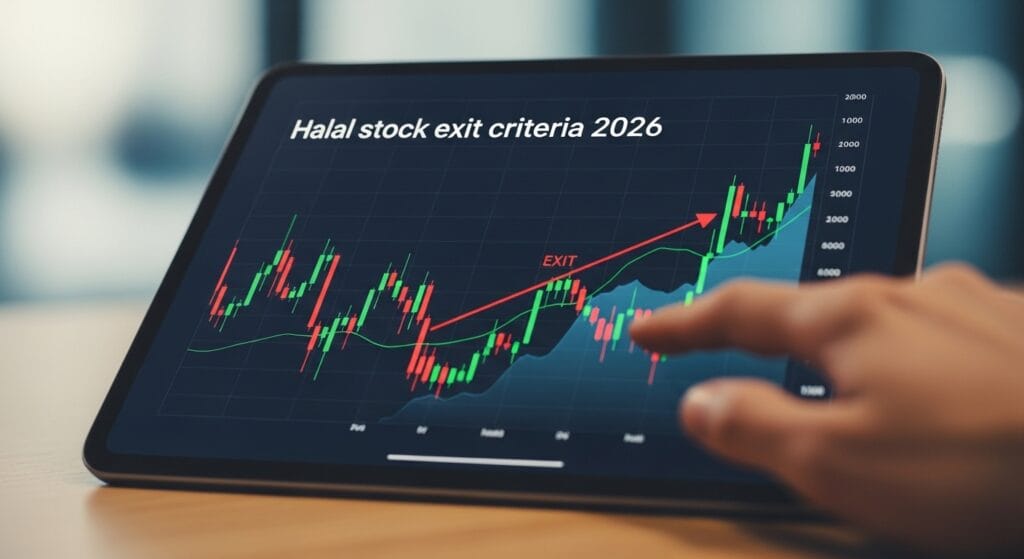
- The Sharia-Compliance Audit: For the ethical investor, the best time to sell is the moment a company’s debt-to-equity ratio or revenue source violates Halal stock exit criteria 2026. Integrity is the ultimate long-term ROI.
- The “Macro-Pivot” Signal: When the Federal Reserve or European Central Bank shifts from “pause” to “hike” in 2026, it is a massive Stock Sell Signal 2026. Don’t fight the central banks.
- The Quantitative Peak Indicator: Watch for the RSI (Relative Strength Index) hitting above 80 on the weekly chart. When everyone is “greedy” and the index is screaming overbought, that is your Best time to sell stocks for maximum gains.
- The Rebalancing Trigger: If one stock now occupies more than 15% of your total portfolio due to its growth, sell the excess. This is essential Asset allocation for retirees to avoid “concentration risk.”
- The Tax-Efficient Exit: Sell your “losers” at the end of the fiscal year to offset your “winners.” This Capital Gains Optimization keeps more dollars in your pocket and less in the hands of the taxman.
II: Essential Checklist Before You Hit the “Sell” Button
- Check the RSI: Is the stock in the “Oversold” or “Overbought” territory? Avoid selling at the bottom of a temporary dip.
- Verify Sharia Status: Has the company recently engaged in interest-based acquisitions that make it non-compliant?
- Review Earnings Calendar: Is an earnings report due in 48 hours? In 2026, “selling the news” is often safer than gambling on the report.
- Assess Your USD Needs: Do you have a 24-month cash moat? If not, taking profits now to build liquidity is a top priority.
- Evaluate the “Moat”: Has a new AI competitor rendered this company’s business model obsolete? If yes, exit regardless of the price.
III (Table 1): 2025 vs. 2026: The Evolution of Exit Strategies
| Strategy Metric | 2025 Accumulation Phase | 2026 Strategic Exit Phase | $ USD Strategic Impact |
| Primary Goal | Buy-and-Hold Growth | Capital Preservation & Yield | Guaranteed Liquidity |
| Sell Trigger | 15% Drop | 7% Hard Stop-Loss | Reduced Drawdowns |
| Profit Target | “To the Moon” | Incremental Take-Profit | Consistent Cash Flow |
| Market Focus | Speculative Tech | Defensive Value & AI-Yield | Inflation Protection |
IV: The Psychology of the 90 Percent Rule in Trading
The 90 percent rule in trading suggests that 90% of retail traders lose 90% of their money in the first 90 days. Why? Because they lack a Stock exit strategy for beginners. In 2026, the market is a psychological battlefield. Most investors “marry” their stocks, refusing to sell even when the Best indicators to sell stocks are screaming red. To win, you must treat your stocks like employees: if they don’t perform, they get fired. Emotional attachment to a ticker symbol is a fast track to poverty. By setting a Stop loss vs take profit strategy before you even enter the trade, you remove the human error that leads to catastrophic losses.

V: Terminology for the 2026 Market Strategist
- Stock Sell Signal 2026: A specific technical or fundamental event that triggers an immediate liquidation of a position.
- Capital Gains Optimization: The process of timing sales to minimize tax liability while maximizing net $ USD returns.
- Market Timing Indicators: Tools like the 200-day Moving Average or MACD used to spot a Stock market peak 2026.
- Halal stock exit criteria 2026: The religious and ethical boundaries that mandate selling a stock when it no longer aligns with Sharia law.
- Quantitative Analysis for Stock Selling: Using hard data and AI-driven models to determine the most objective exit point.
VI: The 7 Golden Rules of Portfolio Rebalancing
- Sell the “Hype”: If a stock is trending on social media and everyone is talking about it, the peak is likely in.
- Respect the 200-Day EMA: If a stock breaks below its 200-day Exponential Moving Average, the long-term trend has shifted. Sell.
- Harvest Losses Monthly: Don’t wait until December. Selling stocks at a loss periodically can reduce your tax burden throughout the year.
- Target 20% ROI: For beginners, taking profits after a 20% gain is a proven way to build a winning habit.
- Ignore “Price Targets”: Analysts are often late. Trust the price action on your screen, not a report from three months ago.
- Watch the “Dollar Moat”: If the $ USD is strengthening rapidly, it might be time to move out of volatile emerging market stocks.
- Trust Your “Why”: If the reason you bought the stock (e.g., a specific CEO or product) is gone, you should be gone too.
VII (Table 2): Maximizing Investment ROI in 2026
| Action Pillar | Specific 2026 Tactic | Expected Outcome | Priority |
| Profit Taking | Take profit levels for AI stocks | Locked-in $ USD Wealth | Critical |
| Risk Management | Stop loss vs take profit strategy | Protection from Market Crashes | High |
| Tax Planning | Tax-efficient stock selling | Higher Net After-Tax ROI | Medium |
| Ethics Check | Halal stock exit criteria 2026 | Sharia-Compliant Wealth | Critical |
VIII: Selling Stocks During Inflation 2026
Inflation in 2026 has become a “sticky” reality. This changes the math on When to sell a stock for profit. If inflation is at 5%, a 5% gain is actually a 0% real return. To achieve Investment ROI maximization 2026, you must seek outperformance. If a stock is stagnating while inflation rises, it is a “dead asset.” Selling these underperformers to move into Inflation-Proof Yield or commodities is a standard move for the professional European investor. Don’t let your purchasing power rot in a “safe” stock that can’t beat the rising cost of living.

IX: 3 Exit Concepts for the Modern Retiree
- The Dividend-Capture Exit: Selling a stock immediately after the “ex-dividend” date if the growth potential has peaked.
- The “Life-Stage” Liquidation: A planned, 12-month Stock Market Exit Points strategy to transition from equity to USD High-Yield Savings.
- The Multi-Asset Pivot: Selling high-performing stocks to buy undervalued real estate or tokenized assets in the 2026 market.
X: Essential Checklist for “Peak” Detection
- Is the CEO selling? Check SEC Form 4 filings; if the leaders are exiting, you should consider it too.
- Is the P/E ratio at a 10-year high? Extreme valuations are a magnet for a correction.
- Has the volume “thinned out”? A rising price on low volume is a classic Sign of a stock market peak 2026.
- Are you seeing “Euphoria”? If your non-investor friends are asking for “hot stock tips,” the top is near.
- Does the “Story” still hold? If the company’s 2026 AI roadmap has been delayed, the stock’s premium is at risk.
XI (Table 3): Exit Strategy for Different Risk Profiles
| Investor Type | Recommended Sell Rule | Target Holding Period | $ USD Goal |
| Conservative | 5% Profit / 3% Loss | 1 – 3 Months | Capital Preservation |
| Moderate | 15% Profit / 7% Loss | 6 – 12 Months | Balanced Growth |
| Aggressive | 40% Profit / 10% Loss | 1 – 2 Years | Maximum ROI |
| Sharia-Conscious | Compliance Breach | Event-Driven | Ethical Wealth |
XII: Achieving Investment ROI Maximization 2026
The 2026 market doesn’t reward loyalty; it rewards agility. Achieving Investment ROI Maximization 2026 requires you to view your portfolio as a dynamic entity. When to sell stocks for beginners often feels like a failure, but in reality, it is the highest form of discipline. Securing your $ USD profits ensures that you can live the life you planned, rather than being a slave to the daily fluctuations of the Nasdaq or the DAX. Remember: The market is a tool for your freedom, not the other way around.
XIII: 5 Mistakes to Avoid When Selling Stocks
- Selling Too Early (“The Paper Hands”): Cutting your winners at 2% because you’re scared of a tiny dip.
- Holding Too Long (“The Bag Holder”): Watching a 50% gain turn into a 10% loss because you “believed” too much.
- Ignoring the Tax Bill: Forgetting that selling for a profit in Europe can trigger significant capital gains tax.
- Selling in a Panic: Liquidating everything on a “Red Monday” instead of following your pre-set Stop loss strategy.
- Recycling into Rubbish: Selling a great company just to buy a “cheap” speculative stock that is falling for a reason.
XIV: The “Crisis” Exit Checklist
- Do I have 24 months of cash? If no, sell until you do.
- Is the macro-trend bearish? If the 200-day Moving Average is sloping down, sell the rallies.
- Are my Sharia filters green? If a company starts dealing in high-interest debt, exit immediately.
- Is my stress level high? If you can’t sleep, you are “over-leveraged.” Sell until you can sleep.
- Is the “Dollar Moat” secure? Ensure your exit proceeds are held in a stable $ USD account.
XV (Table 4): The “Real” Profit After Tax and Inflation
| Nominal Gain | Tax (Estimate 25%) | Inflation (5% Est.) | Real Net $ USD Profit |
| 10% | 2.5% | 5.0% | +2.5% |
| 20% | 5.0% | 5.0% | +10.0% |
| 50% | 12.5% | 5.0% | +32.5% |
XVI: Ethical Profit-Taking Strategies
In the 2026 financial landscape, Ethical profit-taking strategies are becoming a primary driver for institutional and retail capital. This means more than just following Halal stock exit criteria 2026. It involves selling positions in companies that engage in environmental destruction or social exploitation. By Securing investment profits in USD from ethical companies, you ensure your wealth is built on a sustainable foundation. Modern European investors are increasingly realizing that “Good Money” is better than “Fast Money.”

Conclusion: Securing Your Financial Future
In the fast-paced markets of 2026, the difference between a wealthy investor and a struggling one is a single word: Discipline. Selling a stock is not an admission of defeat; it is the final act of a successful plan. By following the 7 percent rule for selling stocks and maintaining strict Halal stock exit criteria 2026, you are building a legacy of sustainable wealth. Don’t let the noise of the crowd distract you from your exit points. Secure your $ USD gains, protect your principal, and always remember that in the stock market, the only profit that matters is the one you actually take.
FAQ for Investors: Crucial Insights on Stock Selling & 2026 Market Trends
How should the stock market do in 2026?
Expect a year of “The Great Bifurcation.” Companies with real AI utility and strong $ USD cash flows will thrive, while “Zombie companies” reliant on cheap debt will face a brutal reality check as interest rates stay higher for longer.
What is the 3-5-7 rule in stocks?
This is a tactical profit-taking framework where you sell 30% of your position at a 3% gain, 30% at 5%, and the remainder at 7% or higher. It’s designed to lock in consistent wins and eliminate the emotional stress of “timing the top.”
What time is the best time to sell stocks?
Historically, the first and last 30 minutes of the trading day offer the highest liquidity but also the highest volatility. For most, the Best time of day to sell stocks is between 10:00 AM and 11:30 AM EST, when the initial market “noise” has settled.
Where should investors put money in 2026?
Capital is migrating toward “Real Value.” This includes high-yield $ USD trenches, tokenized commodities, and AI-infra companies with actual revenue. Avoid speculative “meme” assets that lack a clear path to profitability in a high-inflation environment.
Is 2026 a bull or bear market?
It is a “Selection Market.” While the broad indices might look stagnant, specific sectors like AI-Healthcare and Energy-Tech are in a massive bull run. Success this year depends on active Asset allocation for retirees rather than passive index tracking.
What are the two worst months for stocks?
September and October traditionally hold the title for the highest volatility and frequent “market scares.” For many professionals, August is the Best month to sell stocks for profit to avoid the seasonal September dip and secure summer gains.
Why are all the billionaires selling their stocks?
Ultra-high-net-worth individuals are currently shifting into “Defensive Liquidity.” By selling at the 2026 peaks, they are building massive $ USD cash piles to buy distressed assets when the next cyclical correction or credit crunch hits.
What will $10,000 of Nvidia stock be worth in 10 years?
While impossible to predict exactly, if the company maintains its 80% market share in AI silicon, even a moderate 15% annual growth would see that $10,000 grow significantly. However, a “sell” trigger should be set if competitors break their hardware moat.
What months do stocks crash?
Major market corrections have historically clustered in October (1929, 1987, 2008). While not a rule, the Signs of a stock market peak 2026 often appear in late summer, leading to a “Liquidity Event” in the final quarter of the year.
Who owns 88% of the stock market?
The top 10% of households, along with massive institutional players like BlackRock and Vanguard, control the vast majority of equities. This is why following “Institutional Flow” is a more reliable Stock Sell Signal 2026 than following retail sentiment.
What month is the best month to sell stocks?
April and May often provide a “Spring Peak” as earnings season concludes. The old adage “Sell in May and go away” still holds some weight in 2026 for those looking to protect their Investment ROI maximization before the summer doldrums.
Will Nvidia reach $300?
In the 2026 split-adjusted landscape, reaching $300 would require a total dominance of the Enterprise AI sector. While possible, investors should use Take profit levels for AI stocks at various intervals rather than waiting for a single “magic number.”
Will the stock market rise or fall in 2026?
The market is likely to trend “sideways-up” for high-quality names and “down” for speculative tech. The era of “all boats rising” is over; your success now depends entirely on your Quantitative analysis for stock selling and entry.
When to sell a stock for profit?
The moment the original “Investment Thesis” is met. If you bought a stock to gain 20% and it hits 20%, sell it. Greed is the number one killer of a Stock exit strategy for beginners. Take the money and move on.
When to sell stocks that are losing money?
Follow the 7 percent rule for selling stocks. If it drops 7% from your entry, the trade is broken. Selling at a small loss is a “business expense” that preserves your capital for a better, more profitable setup.
Why do people sell at a loss?
Professional traders sell at a loss to prevent a “small mistake” from becoming a “portfolio killer.” Retailers often sell at a loss due to panic, whereas professionals do it as part of a disciplined Stop loss vs take profit strategy.
Disclaimer: This content is for educational and informational purposes only and does not constitute financial, legal, or religious advice. Financial data and market conditions are subject to change, and we disclaim any responsibility before God for decisions made based on this analysis. It is your personal responsibility to ensure that your earnings and investments align with Sharia principles by consulting specialists or using verification tools where applicable. We are not responsible for any financial losses; seeking permissible sustenance remains your individual accountability.
To master the Science of Profit-Taking in 2026 and ensure your Capital Gains Optimization is based on institutional-grade logic, your exit strategy must be calibrated against global financial standards. We recommend auditing your Stock Sell Signals 2026 against these definitive benchmarks to ensure your wealth is architecturally shielded.
1.The Art of the Exit: Knowing When to Exit: Selling at the Right Time (SBI Securities)
2.The Disciplined Growth Framework:Essential Rules for Stock Market Success(StockAxis)
