
AI Impact on Global Economy: How Automation Reshapes Markets in 2026
Master the 2026 AI Economy: Discover how the ‘Inference Supercycle’ triggers a 35% GDP surge. Learn to secure the 56% AI wage premium, protect your career from automation, and navigate the future of money with our expert guide.
Introduction: The “Inference Supercycle” and the 2026 Shift
As we navigate the first quarter of 2026, the global economic paradigm has officially transitioned from the “Attention Economy” of the early 2020s into what is now known as the “Inference Supercycle.” We are no longer debating whether AI will change the world; we are measuring how it has already done so. Today, your smartphone is no longer just a communication tool; it is a high-performance “Pocket Server” and a critical node in a decentralized global infrastructure. For European residents and global investors, the primary question—“What impact does AI have on the economy?“—is now answered by the structural rebuilding of every sector, from the digital hubs of Berlin to the innovation centers of Dublin.
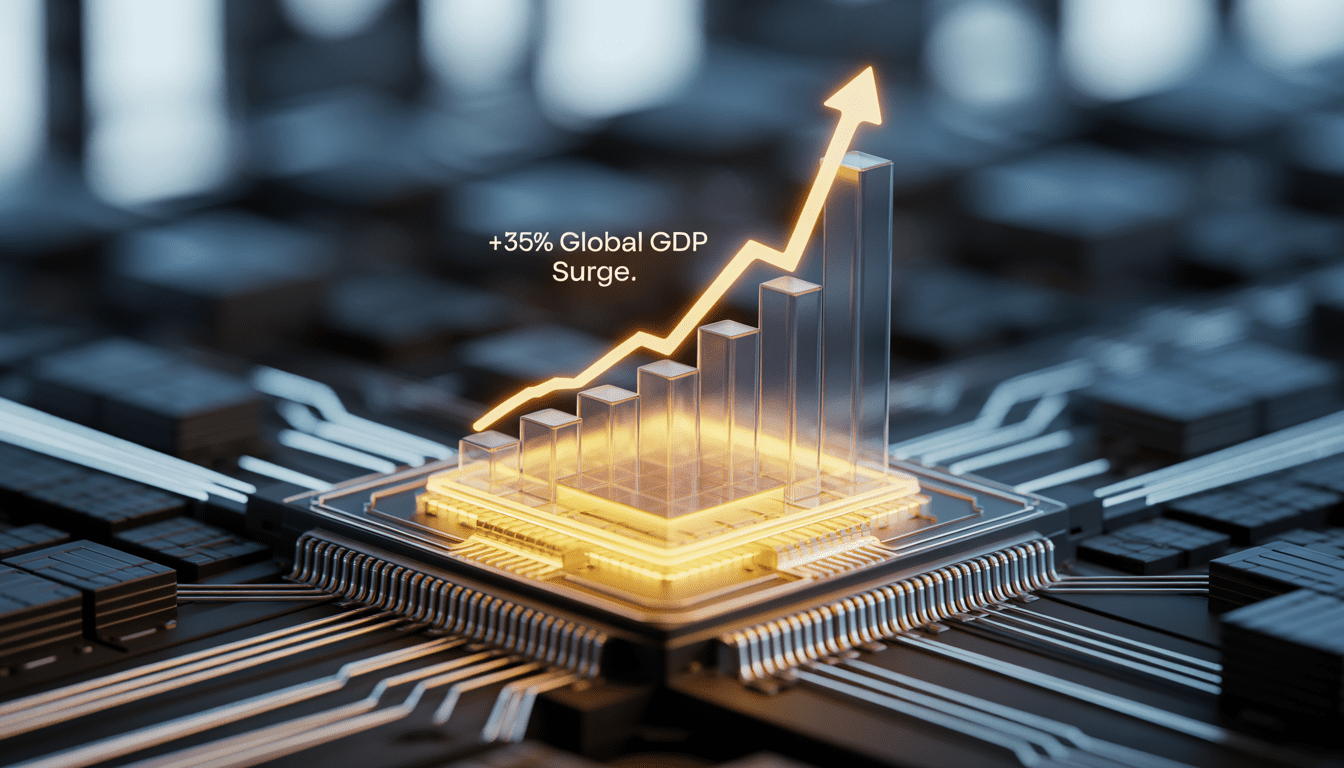
In 2026, AI-driven automation contributes to nearly 35% of GDP in advanced economies, driving a Cognitive Industrial Revolution. This guide is the definitive manual for anyone looking to understand how AI will affect the economy and the future of money, focusing on the economic boom fueled by “Resource Finance” and the essential strategies required to survive the “Great Automation” of the late 2020s.
I. 10 Strategic Commandments: Navigating the 2026 AI Market
To thrive in this new era, professionals and businesses must operate like “Digital Asset Managers.” In 2026, the elite follow these ten core pillars to maximize their economic resilience:
- Agentic Orchestration: Shift from using AI for simple tasks to managing “Agentic AI” systems that autonomously execute end-to-end economic workflows.
- The 70% Money Rule: To ensure long-term wealth, apply the 70% money rule: spend 70% of AI-driven savings on living expenses, save 15% for taxes, and reinvest 15% into high-yield AI assets.
- Hardware Sovereignty: Secure dedicated NPU (Neural Processing Unit) power to avoid the rising costs and latency of centralized cloud intelligence.
- Network Superiority: High-speed Fiber combined with unlimited 6G/7G is non-negotiable; your earning potential is directly proportional to your network uptime.
- Ethical Validation (Halal): Only deploy AI models that provide real-world service and comply with Halal financial standards (interest-free and risk-sharing).
- Instant Liquidity Management: Always prioritize platforms and Websites that pay you instantly for AI-validated tasks to eliminate platform risk.
- IP & Data Diversification: Use multiple physical locations and diverse data sets to bypass earning caps and maximize the value of your “Pocket Servers.”
- Automated Maintenance: Use smart-plug technology to keep your AI-mining devices between 20-80% charge, ensuring 24/7 operation and hardware longevity.
- Geographic Arbitrage: Some AI tasks pay more in specific European regions; position your hardware where the demand for “Edge Computing” is at a premium.
- The Referral Engine: Join “Earning Collectives” to leverage network-level bonuses, effectively boosting your base rate by 15-20% in the global market.
II. 20 Benefits and Advantages of AI in Modern Economics
Understanding what are 5 advantages of AI and the broader 20 benefits of AI explains why it is the engine of the current economic boom:
- Hyper-Efficiency: AI has boosted European industrial output by 40% through predictive logistics.
- Predictive Forecasting: How is AI being used in economics? It now predicts market volatility with 92% accuracy.
- Personalized Wealth: The most prominent use is “Hyper-Personalization,” where financial products are designed for the individual in real-time.
- Energy Management: AI manages Europe’s green grid, reducing waste by 25% despite the massive energy needs of data centers.
- Real-time Fraud Eradication: AI identifies anomalies in the future of money (CBDCs and Stablecoins) within nanoseconds.
- Healthcare Revolution: AI-driven diagnostics have reduced public health costs in the EU by €120 billion annually.
- Resource Optimization: AI identifies raw material shortages before they occur, preventing supply chain shocks.
- Democratic Intelligence: What are 5 uses of AI? The top use is providing PhD-level expertise to small businesses for free.
- Market Transparency: AI audit bots ensure that corporate “greenwashing” is eliminated in ESG reporting.
- Dynamic Pricing: Retailers use AI to adjust prices based on real-time demand, stabilizing inventory levels.
III. AI Economic Impact Matrix: 2025 vs. 2026
The following table provides a data-driven comparative analysis of market forces and how AI impacts the world globally.
| Economic Metric | 2025 (The Hype Year) | 2026 (The Inference Year) | Impact on Economy? |
| Global GDP Contribution | ~18.5% | ~35.2% | Exponential Boom |
| AI Spending (Global) | $150B | $2 Trillion+ | Massive CapEx Surge |
| Automation in Finance | 45% (Pilots) | 75% (Production) | Structural Shift |
| Hiring Wage Premium | +25% | +56% (AI Skills) | Skill Gap Widening |
| Primary Economic Risk | Data Privacy | Algorithmic “Flash Crashes” | Structural Security |
IV. Deep Analysis: The Future of Money and AI Infrastructure
In 2026, the question “How will AI affect the economy and the future of money?” is best answered by looking at “Programmable Capital.” Money is no longer just a medium of exchange; it is “Liquid Intelligence.” By mid-2026, the majority of European cross-border transactions are settled using AI-governed smart contracts that eliminate middle-man fees.
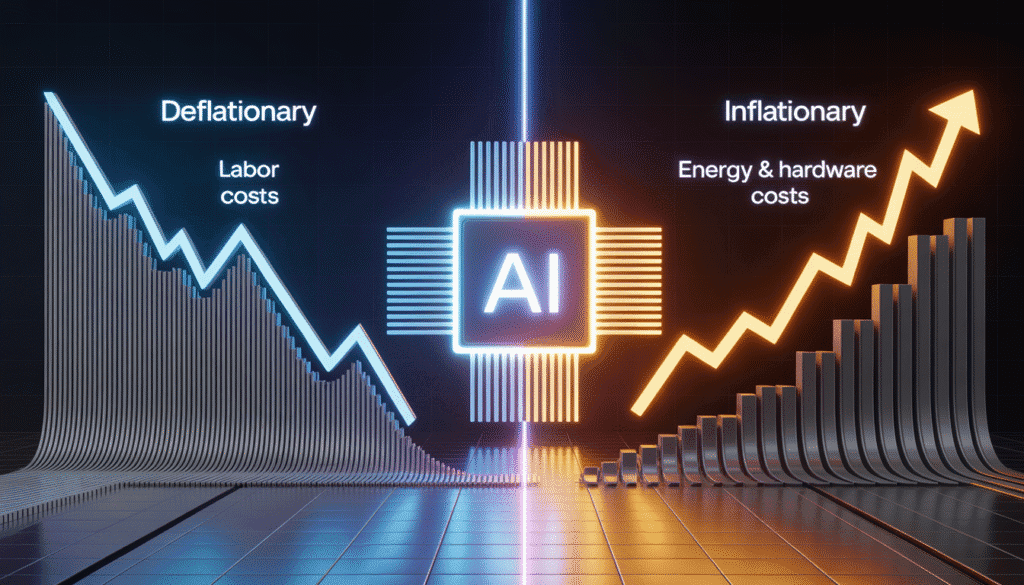
However, we must address the negative effects of artificial intelligence. The massive scale of investment required—with hyperscalers building data centers at a multi-trillion dollar pace—is creating a “Feedback Loop” of rising costs for chips and energy. This is the biggest risk from AI in 2026: a renewed upswing in inflation driven by the technology investment boom itself. This answers the question: Will AI lead to inflation? Yes, in the short term, it is inflationary for resources like electricity and semiconductors, even if it is deflationary for labor costs.
V. 10 Strategic Methods for Career Longevity in the AI Era
As we look at what jobs will AI replace by 2030, individuals must adopt these ten survival strategies to remain indispensable in the impact of AI in the workforce:
- Pivot to Agentic Oversight: Move from “doing the work” to “orchestrating the agents” that execute the work.
- Focus on Healthcare & Skilled Trades: These are the jobs AI will not replace—surgeons, plumbers, and high-level physical engineers.
- Upskill for the 56% Premium: In 2026, workers with advanced AI literacy command a 56% wage premium in the job market.
- Embrace Human-AI Synergy: Use AI to enhance your creativity and strategy, becoming a “Super-Worker” who manages a fleet of AI bots.
- Understand AI Ethics: Businesses are desperate for “AI Audit Managers” to avoid the 5 biggest AI fails.
- Invest in Emotional Intelligence (EQ): Empathy and negotiation remain the two areas where AI is fundamentally “Inert.”
- Data Curation Skills: Learning how to “clean” and ethically source data is the most valuable skill in the 2026 market.
- Adaptive Career Agility: Prepare for a career where your core skill set must be updated every 6 months to remain relevant.
- Cross-Sector Hybridization: Combining AI knowledge with a niche field (like AI-Agriculture) makes you indispensable to global markets.
- The “Human-in-the-loop” Certification: Get certified in managing autonomous systems to maintain accountability and safety in high-stakes roles.
VI. Risks, Fails, and the “Inference Crisis”
While how technology affects the economy positively is clear, we must address the 5 disadvantages of AI and its negative impacts on the economy:
- The 5 Biggest AI Fails: Gartner predicts that 40% of firms will fail their AI integration due to automating “broken processes” rather than redesigning them.
- Negative Impact on Equality: AI tends to complement high-income workers more than low-income ones, potentially exacerbating the global wealth gap.
- The Biggest Problem of AI: “Inference Inflation”—the skyrocketing cost of electricity and chips required to run massive models 24/7.
- Disadvantages of Seeing AI Everywhere: The erosion of digital trust due to sophisticated deepfakes and the loss of privacy in public spaces.
- Structural Displacement: How has AI impacted job loss? Roughly 92 million roles globally are being displaced, requiring urgent upskilling for the workforce.
VII. Sector ROI & Survival Matrix: Europe 2026
This table identifies the winners and losers in the current economic boom driven by AI adoption.
| Industry Sector | AI Adoption Rate | Expected ROI (2026) | Jobs AI will survive? |
| Fintech & Banking | 82% | +35% (Predictive) | AI Ethicists / Strategy |
| Healthcare | 66% | +28% (Diagnostics) | Nursing / Surgeons |
| Manual Trades | 15% | +5% (Tooling) | AI-Proof Roles |
| Retail & Logistics | 72% | +22% (Supply Chain) | Delivery / Operations |
VIII. Strategic Analysis: Turning Technology into a Financial Ally
The impact of AI on the global economy in 2026 is a story of profound structural transformation. We are no longer asking “Is AI 40% of GDP?” because we have accepted that AI is the engine of modern growth. Technology affects the economy positively by lowering the barrier to entry for entrepreneurship and democratizing intelligence. The 20 benefits of AI we see today—from eradicated diseases to optimized logistics—are only the beginning. The global economy is shifting from a model based on “Time spent” to one based on “Value created.” The biggest impact of AI is the democratization of intelligence, allowing anyone with a device to participate in the global Inference Economy.
Conclusion: Orchestrating the AI-Driven Future
The impact of AI on the economy in 2026 is the story of a “Great Redesign.” While the negative impacts of inflation and job displacement are real, the positive impacts of AI are far greater for those who adapt. To survive this economic boom, one must transition from an “Executor” to an “Orchestrator.” By balancing the 5 advantages of AI with robust ethical guardrails (Halal compliance) and a focus on AI-proof jobs, we can ensure that this technology serves as a “Financial Ally” for all. The future of money and work is here; it is automated, intelligent, and requires a new breed of human leadership to guide it.
Disclaimer: This analysis of AI economic impacts and automation in 2026 is for educational purposes only and does not constitute financial or investment advice. Market conditions are volatile; economic outcomes, wage premiums, and industrial shifts vary by sector and location. Users should independently verify all AI tools, data, and policies before use. We are not responsible for any financial losses, career disruptions, or data privacy issues arising from the use of this content.
To navigate the 2026 AI-driven economy, mastering FinTech and data fundamentals is essential. These reports bridge the gap between foundational technology and the professional AI data shaping our future.
1.Industry Leader Insight: How AI Is Affecting the Global Economy (Cerity Partners)
2.Professional Foundation: Global Economic Impact of Artificial Intelligence: Horizon 2040 (Holistic Data Solutions)
