
B2B Payment Automation: Top 7 Tools for 2026
Master B2B payment automation in 2026. Reviewing Top 7 tools like Stripe & Bill.com. Learn to cut costs, use AI for invoices, and reclaim your financial control today!
Introduction: Ending the B2B Payment Grind (March 2, 2026)
It is Monday, March 2, 2026. You’re at your desk, the coffee is warm, and you’re looking at a stack of invoices or, more likely, a bloated email inbox filled with pending approvals. If you’re still keying these into your accounting software by hand, you’re losing money. Plain and simple. In the European market, we’ve moved past the “why should we automate” phase; it’s now a matter of survival. You’re here because you want the Best B2B payment automation software 2026 has to offer, and frankly, you want to know which Digital B2B payment trends for 2026 are actually worth your time and which are just hype. This guide isn’t here to sell you a dream—it’s here to tell you how to stop the manual grind, avoid the Riba-heavy debt traps, and get your finance team out of the spreadsheet nightmare.
I.The Current Financial Landscape
- Stop treating payments as an administrative burden; they are the blood of your business. Real-time B2B payment systems for enterprises are no longer a luxury; they are the baseline to keep cash moving.
- If you aren’t already using AI-powered accounts payable automation platforms, you’re paying human salaries for work a script can handle in milliseconds. It’s an easy fix.
- The Future of B2B payments: Automation and Blockchain isn’t about crypto speculation; it’s about using distributed ledgers to settle payments in seconds, not days.
- We are seeing a massive shift in What is the payment trend in 2026? It’s “invisible finance”—systems that talk to each other without you having to export a single CSV file.
- If you are wondering What are the types of B2B payments? they essentially boil down to how fast and how reliably you can move capital between entities while keeping a perfect audit trail.
- The Financial prediction for 2026 is clear: margins are tightening. The businesses that automate their AP and AR will outcompete those that stick to manual, error-prone legacy systems.
- The Next generation payment 2026 isn’t a new credit card; it’s the total removal of friction between your ERP and your bank account.
II. Why You Need to Move Away from Manual Processes
- Manual entry is the #1 cause of payment fraud. When people touch the data, the risk skyrockets. Automated invoice processing and payment tools act as your first line of defense.
- You’ll finally understand your cash flow. Cloud-based B2B payment automation benefits come down to having one dashboard that shows you exactly what’s owed and what’s paid.
- You can negotiate better terms. When you pay on time—every time—you build leverage to ask for better pricing.
- Security isn’t an option. Secure B2B payment gateways for FinTech 2026 allow you to bypass the insecure “send me an invoice via email” workflow.
- You save on headcount. You don’t need to fire anyone, but you can stop hiring “data entry” roles and start hiring “financial analysts.”
III. Table 1: Efficiency Gains from Automation (2026 Estimates)
| Process Area | Manual Cost/Invoice | Automated Cost/Invoice | Time Saved (Hours/Month) |
| Invoice Data Entry | $15.50 | $1.20 | 45 |
| Bank Reconciliation | $22.00 | $3.50 | 80 |
| Vendor Onboarding | $12.00 | $0.80 | 30 |
| Approval Cycles | $18.00 | $1.50 | 60 |
| Dispute Resolution | $25.00 | $4.00 | 120 |
IV. Picking the Right Tool: Don’t Buy the Hype
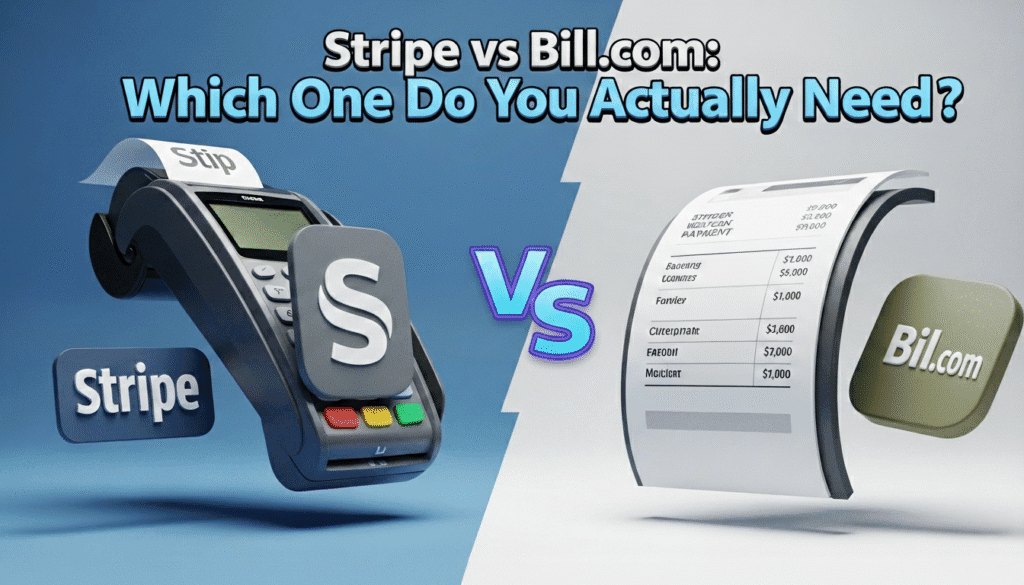
Let’s be real about Stripe vs Bill.com for B2B payment automation. Stop asking which is “better”—ask which one you need. Stripe is a payment gateway. Use it if you are selling software or services and need to collect money from customers globally. Bill.com is an AP/AR workflow tool. Use it if your pain is paying bills and managing vendor approvals. They aren’t the same. The biggest mistake in Integrating B2B payments with ERP systems is trying to force one tool to do the job of the other. If you’re a mid-market firm, you likely need a stack, not a single magic wand. Look for tools that focus on Low-cost B2B payment processing for 2026, and if they hide their FX fees, run away. They’re just another bank in a fancy app suit.
V. What Actually Works (Best Practices)
- Always verify vendor bank details with a phone call. Never trust a “bank change” email.
- Use virtual cards. Best virtual cards for B2B payment management let you kill a card the moment it’s compromised, without shutting down your whole business.
- Set up a “Maker-Checker” rule. The person who adds the vendor should never be the one who authorizes the payment.
- Automate the audit. Your software should keep a permanent log of who approved what, and when.
- Don’t rely on SMS 2FA. If your payment tool doesn’t support hardware keys (like Yubikey), they aren’t serious about security.
VI. How to Automate B2B Payments Using AI
- Map your existing payment flow. If you can’t describe it, you can’t automate it.
- Choose your tool based on your ERP. If it doesn’t sync with your accounting software, it’s a paperweight.
- Standardize your incoming invoices. If your vendors send you photos of paper, tell them to use a PDF generator.
- Set your AI “tolerance” levels. If an invoice matches the PO exactly, let the AI pay it. If it doesn’t, flag it for a human.
- Roll it out in batches. Start with your 10 most reliable vendors. Don’t flip the switch on the whole company at once.
VII. Table 2: Top 7 B2B Payment Tools for Small Business (And Mid-Market)
| Tool Name | Core Competency | Integration Level | Security Score |
| Bill.com | Accounts Payable | High | 9.5/10 |
| Airwallex | Global/Cross-border | Extreme | 9.8/10 |
| Melio | Small Business | Medium | 9.0/10 |
| Tipalti | Mass Payouts | High | 9.7/10 |
| Stripe | Payment Gateway | Extreme | 9.9/10 |
| Brex | Spend Management | High | 9.2/10 |
| Payoneer | Freelance Payouts | Medium | 9.1/10 |
VIII. The Truth About “Payment Methods”
When people ask What are the 5 payment methods?, they usually mean ACH/SEPA, Wire, Credit Cards, Virtual Cards, and Digital Wallets. But the reality is that What is the best payment method for a small business? is almost always an ACH/SEPA transfer, provided it’s automated. It’s cheap, reliable, and predictable. If you are doing international trade, look for Best cross-border B2B payment solutions 2026 that don’t charge you a 3% fee to send money to a neighbor. And regarding Does PayPal do B2B payments?—yes, but it’s often a clunky, expensive way to handle high-volume AP. Use it for one-offs; use specialized AP tools for your core business operations.
IX. Understanding the Landscape
- What are the 4 types of B2B? Producer-to-Business, Business-to-Business, Business-to-Government, and B2B2C.
- What are the payment methods for B2B? (See Table 3 below).
- What is the future of payment technology? It’s invisible. It’s automated. It’s API-first.
- What payments are coming in 2026? More instant rails, more smart-contract-backed transfers.
- What are the top platforms for automating B2B payment transfers? (See Table 2 above).
X. Security and Risks (Do Not Ignore)
- Phishing is getting smarter. Your automated tool should be the only way invoices get into your system.
- Secure B2B payment gateways for FinTech 2026 aren’t just for FinTechs; they’re for anyone moving money.
- Beware of platforms that try to push you into “lending” features. If you need to borrow money to pay your suppliers, you have a cash flow problem, not a payment problem.
- What are the 4 types of B2B? Keep these in mind because your payment needs differ if you’re a manufacturer vs. a service provider.
- Always check the fine print on currency conversion.
XI. Table 3: Risk Level of Payment Methods
| Method | Operational Risk | Financial Risk | Best Practice |
| Paper Check | High | High | Stop immediately |
| Bank Wire | Low | Low | Verify twice |
| Virtual Card | Low | Very Low | Use for subscriptions |
| Direct ACH/SEPA | Low | Low | Primary method |
| Digital Wallets | Med | Med | Use for small/ad-hoc |
XII. Operational Strategy: The “Clean House” Approach
Automation isn’t just about software; it’s about the data you put into it. If your master vendor list is a mess, your automation will be a mess. Spend a weekend cleaning your vendor data. Remove the ones you haven’t paid in two years. Standardize the naming conventions. It’s boring work, but it’s the only way to get your Cloud-based B2B payment automation benefits to actually pay off. Once the data is clean, you can use How to automate B2B payments using AI to set up rules that actually trigger. If the data is dirty, the AI will just make mistakes faster than you ever did.

XIII. Quarterly Planning Checklist (To-Do)
- Audit Vendors: Prune your list. Keep it clean.
- Review Fees: Check if your payment provider is raising rates (they do this often).
- Security Check: Change passwords, rotate API keys, force 2FA checks.
- Contract Review: See if your suppliers will give a discount for paying early via your new automated system.
- Integration Sync: Does your ERP still see the right numbers from your payment app? Check it.
XIV. Ethical Principles (The “Good Business” Checklist)
- Be transparent with your vendors. Tell them you’re moving to an automated system—it makes their life easier too.
- Avoid predatory financing. If a payment app offers you a loan at 20% APR, say no.
- Prioritize data sovereignty. Make sure you can export your records at any time.
- Don’t over-complicate. The best system is the one your team actually uses.
- Stay compliant. In Europe, keep your data residency rules in mind.
XV. Table 4: The 2026 Roadmap
| Focus | Q1 | Q2 | Q3 | Q4 |
| Infrastructure | Sync ERP | Audit Data | Cleanup | Optimize |
| Payments | Virtual Cards | Switch AP | RTP | FX Audit |
| Compliance | Security | Audit | Policy | Review |
XVI. Final Reality Check
You have the roadmap. The Financial prediction for 2026 is that the gap between companies that use these tools and those that don’t is going to widen. It’s not just about speed; it’s about control. When you automate, you stop guessing your bank balance and you start knowing it. That’s power. Start small. Pick one tool, sync it with your accounting software, and get your first invoice paid automatically. It’s a great feeling. Then, do it for the rest. Don’t look for a miracle; just look for the friction and remove it.

Conclusion: Reclaiming Control of Your Back Office
B2B payment automation in 2026 isn’t a complex, impossible task. It’s just business hygiene. You are organizing your back office so you can spend your time building your business rather than chasing invoices. Use the tools that give you control, ignore the ones that hide fees or push debt, and keep your integration simple. You don’t need a massive team of accountants; you need a clean system and the discipline to use it. Start today, keep it simple, and stay ahead of the curve.
Disclaimer: This content is for educational and informational purposes only and does not constitute financial, legal, or religious advice. Financial data and market conditions are subject to change, and we disclaim any responsibility before God for decisions made based on this analysis. It is your personal responsibility to ensure that your earnings and investments align with Sharia principles by consulting specialists or using verification tools where applicable. We are not responsible for any financial losses; seeking permissible sustenance remains your individual accountability.
To ensure your B2B Payment Automation Strategy 2026 is built on a foundation of professional-grade resilience and financial transparency, we have integrated a selection of global benchmarks from leading fiscal authorities. We strongly recommend aligning your implementation roadmap and cross-referencing your security protocols with these trusted global standards to achieve maximum cash flow control with minimal risk.
1.Industry Standard:B2B Payment Automation: A Definitive Guide for Businesses (Stripe Resources)
2.Advanced Payment Engineering: 8 Best Payment Orchestration Platforms Compared: 2026 Merchant’s Guide (Solidgate Blog)
