
How to Diversify Your Retirement Portfolio for Income & Stability in 2026
Build a resilient retirement portfolio for passive income in 2026. Our deep-dive guide covers the 5 pillars of non-correlated diversification, from TIPS and Gold to Managed Futures. Protect your principal against sequence-of-returns risk and inflation today.
Introduction: The Great Reset of Retirement Diversification
The operating thesis that governed post-Global Financial Crisis (GFC) retirement portfolio diversification—namely, the efficacy of the 60/40 equity/bond split—is fundamentally obsolete. Entering 2026, the global financial landscape is characterized by structural dis-correlation, where traditional safety nets fail due to synchronized shocks from elevated rates and persistent inflation. The strategic imperative for retirees is not merely growth, but the rigorous pursuit of real returns that surpass the 3.5%–4.5% structural inflation baseline.
The challenge is dual: generating sufficient, dependable passive income while simultaneously fortifying the principal against both sequence-of-returns risk and the systemic erosion caused by inflation. This paper provides a deep dive into the multi-layered diversification strategy required to stabilize capital flow and optimize your retirement portfolio for passive income through the anticipated turbulence of the mid-2020s. We detail the necessary pivot from conventional to non-correlated asset classes, ensuring your wealth remains a tool for financial sovereignty and “Barakah” (blessing) in a fragmented world where the margin for error has vanished.
Part I: The Seven Pillars of a 2026 Sovereign Portfolio
To effectively diversify retirement portfolio in the current regime, a retiree must move from a “set and forget” mindset to a “dynamic defensive” posture. Here are the seven critical pillars:
- Elimination of the Bond-Equity Illusion: Accepting that in 2026, bonds no longer provide an automatic hedge when inflation spikes; they move in tandem with stocks.
- The 8% Nominal Hurdle Rate: Recognizing that your portfolio must generate 8% annually just to sustain a 4% lifestyle against the 4% “sticky” inflation rate.
- Active Duration Management: Keeping fixed-income duration below 3.5 years to survive the ongoing “higher-for-longer” interest rate environment.
- The Pricing Power Filter: Investing exclusively in “Quality” companies that can raise prices without losing market share as their own input costs rise.
- Hard Asset Integration: Shifting at least 20% of the portfolio into tangible, productive assets like infrastructure, gold, and energy-producing farmland.
- Mechanistic Rebalancing Protocols: Using “Tolerance-Based” rules (rebalancing at 5% deviations) instead of the calendar to execute trades only when risk shifts.
- The Ethical (Halal) Sovereignty: Purging the portfolio of usury-based debt traps and speculative bubbles that lack productive real-world value.

Part II: Core Vulnerabilities and Behavioral Landmines
- The Synchronized Shock Threat: Central bank rate hikes in 2026 simultaneously depress bond valuations and equity multiples, leaving 60/40 portfolios with nowhere to hide during volatility.
- The Erosion of Real Purchasing Power: Nominal gains are a dangerous trap; if your portfolio grows by 5% but inflation is 4.5%, your “Real Wealth” is effectively stagnant.
- Sequence-of-Returns Risk: A market crash in the early years of retirement, combined with forced withdrawals for living expenses, leads to irreversible capital depletion.
- The Behavioral “Panic” Loop: AI-driven volatility in 2026 triggers the “Loss Aversion” bias, causing retirees to sell at market bottoms and lock in permanent losses.
- Confirmation Bias in a Fragmented World: Relying on outdated “growth” narratives while ignoring the pivot toward the “Physical Economy” and real-world utility assets.
- The Complexity Trap: Over-investing in complex “structured products” that offer high yields but hide massive systemic risks that only appear during a liquidity crisis.
Key Financial Benchmarks for 2026 Portfolio Stability
The following table identifies the minimum quantitative targets required to ensure your retirement income remains resilient in the current high-rate, high-inflation environment.
| Performance Metric | 2026 Target Benchmark | Strategic Purpose for the Retiree |
| Target Real Return | > 3.5% (Post-Inflation) | Ensures the principal’s purchasing power grows over time. |
| Maximum Portfolio Duration | < 3.5 Years | Minimizes sensitivity to ongoing central bank interest rate hikes. |
| Real Asset Allocation | 15% – 25% | Acts as the primary “Insurance Policy” against currency debasement. |
| Emergency Buffer (Bucket 1) | 24 Months of Expenses | Prevents “Forced Selling” of assets during market downturns. |
| Maximum Annual Drawdown | < 12% (Peak to Trough) | The critical limit to protect the long-term compounding engine. |
| Passive Income Coverage | 1.2x of Monthly Spend | Ensures life is funded by yield, not by liquidating principal. |
| Sharpe Ratio Target | > 0.85 | Confirms that returns are being generated efficiently per unit of risk. |
Part III: Reengineering the Income Engine
The allocation to bonds in retirement portfolio must be strictly limited to short duration and explicitly inflation-hedged instruments. In 2026, the goal of fixed income has shifted from “Yield Maximization” to “Liquidity and Capital Preservation.” This requires the use of Treasury Inflation-Protected Securities (TIPS) as a foundational anchor and Floating Rate Notes (FRNs) to capture rising yields dynamically. Furthermore, the equity portion of your retirement portfolio for passive income must pivot toward Global Dividend Growth Stocks (DGI).
These companies demonstrate margin resilience by increasing dividends annually, providing a “Halal” and productive hedge against inflation. In 2026, we prioritize Free Cash Flow (FCF) coverage over simple yield, ensuring that the income stream is sustainable even during prolonged regional recessions. This strategy decouples your survival from the volatility of speculative growth sectors, focusing instead on the “Real Economy” of essential goods and services. True diversification is not about having many things; it is about having non-correlated things that do not move together when the world changes.
Part IV: Actionable Tactics for Pillar Execution
- Implement the Bond Ladder: Construct a 1-to-3 year ladder of ultra-short corporates and TIPS to ensure you have cash maturing every quarter for living expenses.
- Filter for FCF Yield: Use screeners to find companies with a Free Cash Flow yield above 6%, which provides the safest “Halal” dividend floor in 2026.
- Deploy Managed Futures: Allocate 5-10% to trend-following funds that can go “long” or “short” across commodities and currencies, providing a hedge that makes money when markets crash.
- Secure Physical Sovereign Assets: Maintain a 5% allocation in physical gold as a non-digital liquidity hedge against systemic financial shocks or banking failures.
- Utilize Buffered ETFs: For the “Core” of your equity portfolio, use products that offer a 15% downside buffer to mitigate sequence-of-returns risk during market corrections.
- The 72-Hour Behavioral Rule: To combat biases, enforce a 72-hour waiting period before executing any major trade suggested by social media or news cycles.
- Conduct a Bi-Annual “Barakah” Audit: Ensure your investments are not tied to industries that harm society, as ethical growth is structurally more stable and less prone to regulatory shocks.
Part V: Global Decoupling and Real Asset Integration
- International Stocks for Diversification: Move beyond the U.S. market; focus on Emerging Markets with high GDP growth that are decoupled from Western debt cycles and Federal Reserve policy.
- Infrastructure as a CPI-Link: Invest in publicly traded infrastructure or utility REITs where revenue is legally tied to inflation, guaranteeing that your passive income grows alongside your bills.
- The Value Factor Advantage: In high-rate regimes, “Value” stocks outperform “Growth” because their cash flows are immediate (low duration) rather than distant and speculative.
- Commodity Baskets as Hedges: Use a small (3%) allocation to broad commodity ETFs (Energy, Minerals, Agriculture) to serve as an “Early Warning System” for inflation spikes.
- Currency Sovereignty: For expatriates, ensure assets are diversified across at least two major currencies (e.g., USD and EUR/CHF) to protect against local currency devaluations.
- Real Estate Yields: Focus on “Niche Real Estate” (like data centers or medical offices) that have long-term tenants and high-demand utility in the 2026 economy.
2026 Quantitative Review Framework (Audit Checklist)
Use this comprehensive table annually to audit whether your diversify retirement portfolio strategy is functioning as an anti-fragile architecture or just “Paper Diversification.”
| Audit Metric | Calculation Method | Significance for 2026 Portfolio |
| The Real Return Check | Nominal Return – 4.5% | If this is negative, your wealth is disappearing regardless of nominal gains. |
| Correlation Coefficient | Pillar A vs Pillar B | Must be below 0.5; otherwise, your diversification is an illusion. |
| Dividend Coverage Ratio | FCF / Dividends Paid | Must be > 1.5x to ensure your passive income is safe from cuts. |
| Sharpe Ratio (Risk Adj) | Return / Volatility | Proves if you are getting “paid” for the stress of market movements. |
| Expense Ratio Audit | Total Fees / Portfolio | Must be < 0.8% to prevent the “Fee Siphon” from eating your compound growth. |
| Liquidity Score | Cash Access within 48h | Ensures you have enough “Dry Powder” to capitalize on market crashes. |
| Zakat/Charity Audit | 2.5% of Surplus | Purifies the wealth and ensures the “Barakah” of the retirement plan. |

Part VI: Active Management and the LDI Strategy
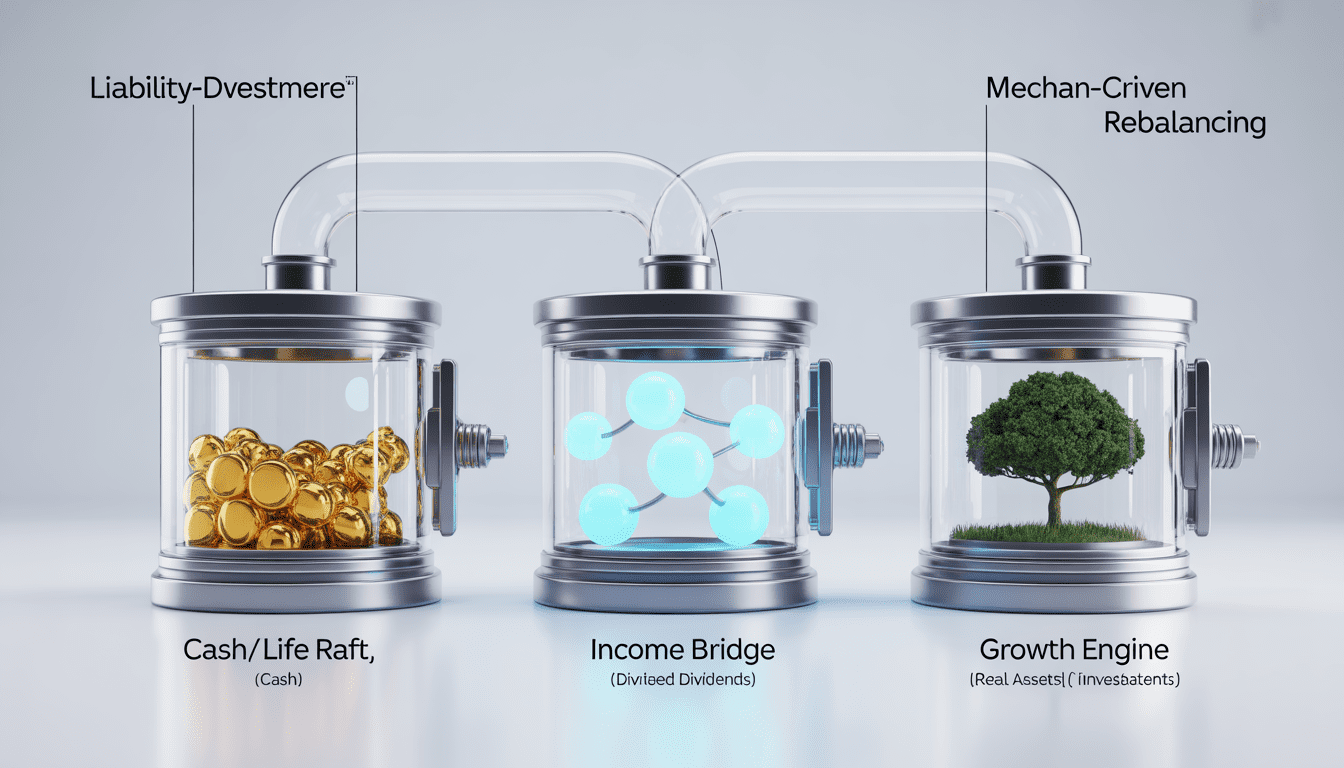
To optimize your retirement portfolio for passive income, you must adopt a Liability-Driven Investment (LDI) approach. This is best executed through a refined “Bucket Strategy.” Bucket 1 contains 2 years of expenses in cash and short-term TIPS—this is your “Life Raft,” ensuring you never have to sell stocks during a crash. Bucket 2 acts as the “Income Bridge,” holding 3–5 years of expenses in DGI stocks and FRNs to refill Bucket 1. Finally, Bucket 3 is your “Inflation-Fighting Growth Engine,” holding equities and Real Assets for the 10-year horizon.
This structure creates a psychological firewall, allowing you to rebalance retirement portfolio based on logic and pre-defined tolerance bands rather than the fear generated by the 24/7 news cycle. By separating “Current Spending” from “Future Growth,” you effectively neutralize sequence-of-returns risk. In 2026, the person who wins is not the one who makes the most profit, but the one who suffers the least drawdown and maintains their dignity and purchasing power against the persistent threats of the new era.
Conclusion: Securing Financial Longevity Through Intelligent Diversification
The economic realities of 2026 necessitate an immediate and profound restructuring of the retirement strategy. Reliance on the efficacy of bonds in retirement portfolio alone is now a strategy for capital erosion. Successful retirement portfolio diversification is achieved not by simple proportional mixing, but by the thoughtful integration of assets that possess distinct, non-correlated risk profiles and specialized functions.
By executing the shift to inflation-hedged fixed income, utilizing international stocks for diversification, integrating real assets, and rigorously committing to rebalance retirement portfolio based on quantitative metrics, the retiree achieves a sustainable architecture. This disciplined, multi-layered approach ensures both the consistent generation of retirement portfolio for passive income and the ultimate preservation of purchasing power. Prosperity in retirement is no longer about the pursuit of wealth, but the defense of freedom and sovereignty in an uncertain world.
Disclaimer: This content is for educational and informational purposes only and does not constitute financial, legal, or religious advice. Financial data and market conditions are subject to change, and we disclaim any responsibility before God for decisions made based on this analysis. It is your personal responsibility to ensure that your earnings and investments align with Sharia principles by consulting specialists or using verification tools where applicable. We are not responsible for any financial losses; seeking permissible sustenance remains your individual accountability.
To master the technical frameworks of asset allocation and explore advanced strategies for generating resilient retirement income in 2026, we recommend consulting these authoritative professional resources.
1.First Dollar Investing: Insights & Resources: Strategic Portfolio Diversification for 2026
2.Internal Revenue Service (IRS): Retirement Topics – Plan Assets and Investment Frameworks
