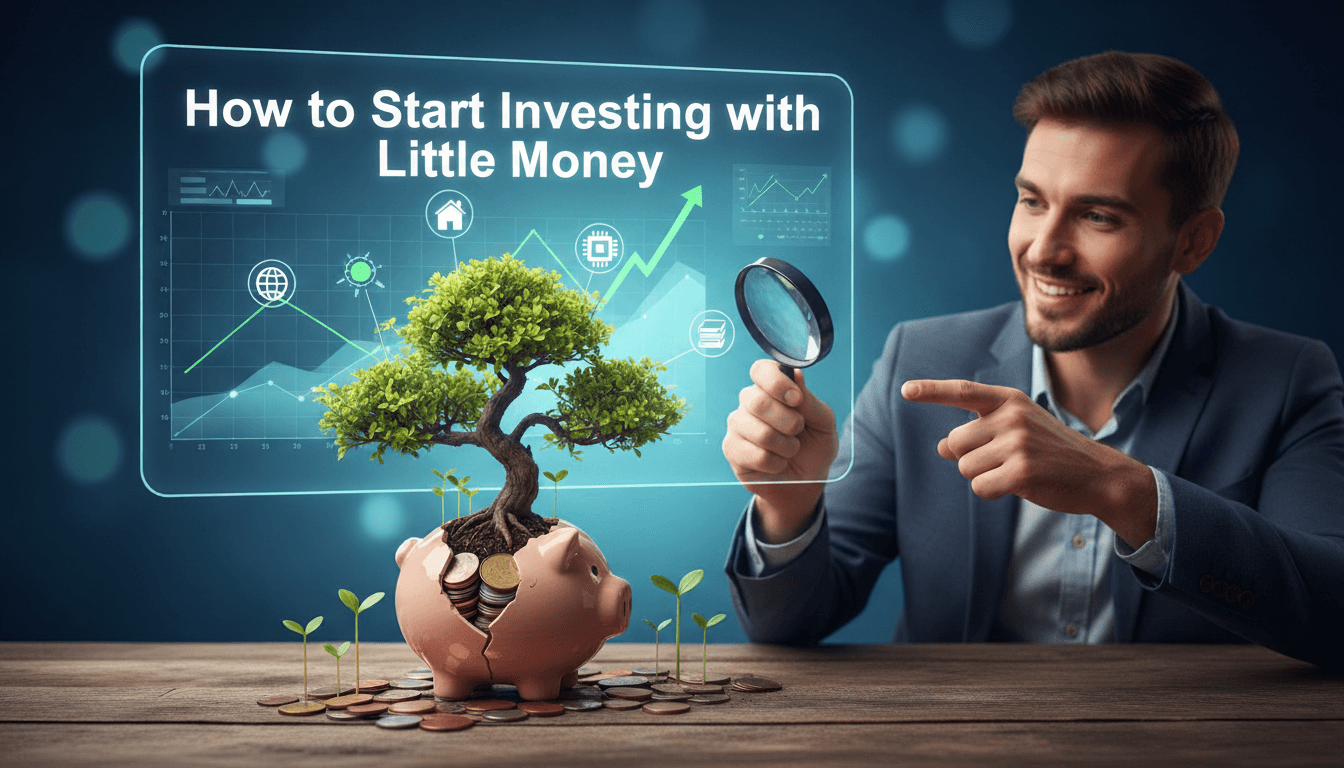
How to Start Investing with Little Money: The Definitive Beginner’s Guide (2026)
Is inflation eating your savings? Discover the velocity of wealth in our 2026 beginner investing guide. Master the best way to invest $100, avoid common psychological traps, and see why starting small today is more powerful than waiting for the perfect moment.
Introduction: The Velocity of Wealth in the 2026 Economy
Listen to me closely: the greatest psychological barrier to wealth in the current decade is the pervasive myth that you need a fortune to start building one. In the economic theater of 2026, we have officially exited the era of “Easy Money” and entered a regime of structural inflation and high-rate stabilization. If you are sitting on the sidelines, waiting until you have a perfect $5,000 to “start,” you are not being cautious—you are actively participating in the erosion of your own future. While you wait, the purchasing power of your stagnant cash is being devoured by a 3-4% inflation rate, and the most powerful engine in the universe—Compound Interest—remains cold and dormant.
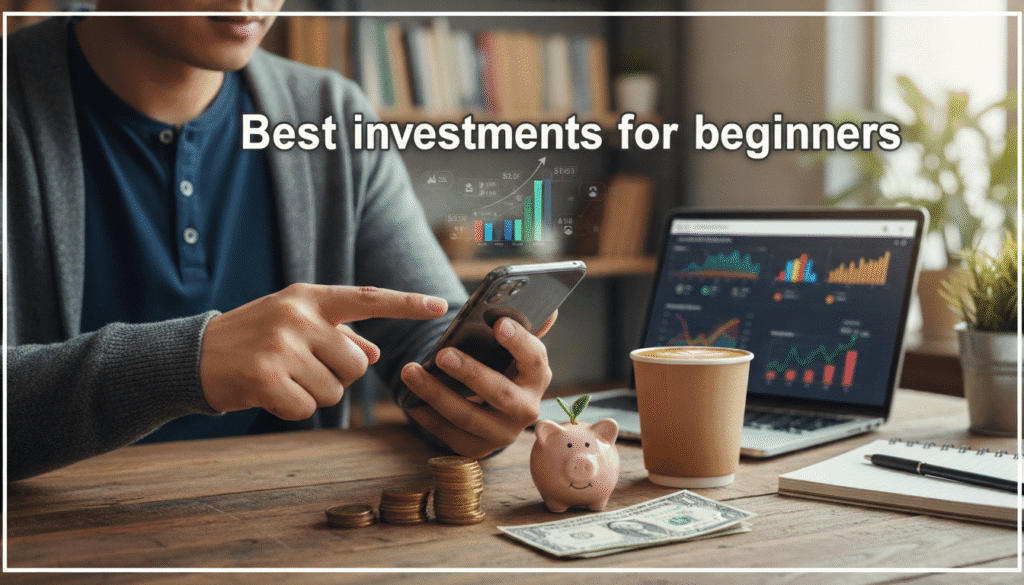
The difference between the billionaire class and the average worker isn’t just their starting capital; it is their Velocity. I have consulted with individuals who started with less than the cost of a monthly streaming subscription and transformed that “seed capital” into sovereign wealth through disciplined execution. This guide is not just a collection of tips; it is a clinical, tactical blueprint for how to start investing with little money in an era where traditional savings accounts have become financial graveyards. We are going to strip away the Wall Street jargon and focus on the mechanical reality of the best investments for beginners, moving you from a passive spectator of the economy to an active owner of the global productive engine.
I. The Five Fundamental Pillars of “Micro-Investing” in 2026
- The Death of the Traditional Savings Account: In 2026, keeping your money in a standard checking or savings account at a major bank is a form of financial self-sabotage. When inflation is “sticky” at 3.5% and your bank pays you 0.01%, you are mathematically losing 3.49% of your wealth every year. Investing is no longer a luxury for the rich; it is a survival mechanism for the working class to protect the “sweat equity” of their labor.
- Velocity over Volume (The Math of Time): The physics of finance dictates that time is more valuable than money. A 20-year-old who invests just $50 a month will, in almost every historical scenario, outperform a 40-year-old who starts investing $500 a month. You cannot buy back time, but you can buy a future where your money works harder than you do.
- The Sovereign Shield Strategy: Investing is the process of building a “shield” around your lifestyle. By owning assets—stocks, commodities, or real estate—you are hedging against the devaluation of the currency you earn. In 2026, being an “owner” is the only way to stay ahead of the AI-driven productivity gains that are concentrating wealth in the hands of capital owners.
- The Behavioral Habit Loop: True wealth is a byproduct of behavior, not intelligence. By learning how to begin investing in stocks with small amounts, you are building the “mental muscle” and emotional resilience required to manage six or seven-figure portfolios later. If you cannot manage $100 with discipline, you will certainly lose $100,000 to panic.
- The Fractional Ownership Revolution: We have reached the pinnacle of financial democratization. In 2026, the “gatekeepers” are gone. You no longer need thousands of dollars to own a piece of the world’s most dominant companies. Fractional shares allow you to buy a $1 “slice” of any mega-cap stock, ensuring that your $100 grows at the exact same percentage rate as a billion-dollar institutional fund.

II. Operational Infrastructure and Tactical Steps for Beginners
- The High-Yield Safety Net (HYSA): Your first move isn’t the stock market; it’s securing your base. In 2026, High-Yield Savings Accounts are yielding 4.5% to 5%. This is where your emergency fund (3-6 months of expenses) must live. It provides the “psychological permission” to take risks in the market without fearing for your rent money.
- The Fractional Revolution and Brokerage Selection: Choosing the best broker for retirement accounts or standard investing is critical. You need a platform that offers zero-commission trades and robust fractional share support. This technology is the absolute best way to invest $100 because it allows you to diversify across 50 companies with a single Benjamin Franklin bill.
- The “Match” Grab (The Only Free Lunch): If your employer offers a retirement contribution match (like a 401k or European pension scheme), leaving it on the table is the greatest financial sin you can commit. This is an immediate, guaranteed 100% return on your money—an ROI that even the greatest hedge fund managers in history cannot replicate consistently.
- The Robo-Advisory Autopilot: For many beginners, “analysis paralysis” is the enemy. Robo-advisors in 2026 use advanced algorithms to manage your $100 based on your risk tolerance. They handle the rebalancing, the tax-loss harvesting, and the asset allocation, allowing you to focus on increasing your income while your wealth grows in the background.
- The Anti-Inflation Hedge (TIPS and Commodities): In a 2026 landscape where inflation remains a threat, the modern beginner has access to ETFs that track “Real Assets.” Including a small percentage of inflation-protected securities ensures that your portfolio has a “floor” even if the currency devalues faster than expected.
III. 2026 Starter Asset Matrix – Where to Put Your First $1,000
The following matrix breaks down the asset classes available to micro-investors in 2026, providing a clear view of risk versus potential reward in a high-rate environment.
| Asset Class | Entry Barrier | Projected 1-Year ROI | 2026 Risk Level | Strategic Purpose |
| High-Yield Savings | $1.00 | 4.2% – 4.8% | Zero | Cash Reserve & Safety |
| S&P 500 ETF (VOO) | $1.00 (Fractional) | 8.0% – 11.0% | Moderate | Core Long-Term Growth |
| Total World Stock (VT) | $1.00 (Fractional) | 7.5% – 10.0% | Moderate | Global Diversification |
| Dividend Aristocrats | $1.00 (Fractional) | 6.0% + Yield | Low / Moderate | Passive Income & Stability |
| AI-Infrastructure ETF | $1.00 (Fractional) | 12.0% – 20.0% | High | Aggressive Wealth Building |
| Short-Term Treasuries | $10.00 | 4.0% – 4.5% | Very Low | Capital Preservation |
IV. Deep-Dive Analysis – The “Coffee Capital” Strategy
The best way to invest $100 is to view it through the lens of “Coffee Capital.” The average person in 2026 spends roughly $100 to $150 a month on temporary comforts—premium coffee, subscriptions they don’t use, and impulse purchases. By redirecting this “wasted” capital into the “Wealth Ladder,” you are buying shares in the very companies that sell those comforts.
In the 2026 market, we are navigating a “Post-Landing” stabilization phase. The Federal Reserve and global central banks have moved away from emergency hikes, creating a “Goldilocks” environment for stocks. For the beginner, this means the best investments for beginners remain Broad Market ETFs. Why? Because the market is a “self-cleansing” mechanism. When you own an S&P 500 ETF, you are betting on the survival of the fittest. If a massive corporation fails or becomes obsolete due to AI, it is systematically removed from the index and replaced by a leaner, more profitable company. By owning the index, you ensure you are always riding the wave of the winners while the losers are purged from your portfolio without you having to read a single balance sheet.
V. Strategic Roadmap to Scalable Wealth (The 7-Step Ladder)
- Step 1: The Liquidity Base: You cannot invest effectively if you are one flat tire away from debt. Ensure 3 months of survival expenses are in your HYSA.
- Step 2: The Anchor Fund: Put your first $100 into a Total Stock Market ETF (like VTI). This gives you exposure to thousands of companies instantly, from tech giants to industrial leaders.
- Step 3: The Automation Rule: Wealth is built on autopilot. Set up a recurring transfer of $25 every week. This utilizes Dollar-Cost Averaging (DCA), ensuring you buy more shares when the market is “on sale” and fewer when it is expensive.
- Step 4: The Dividend Snowball: Enable DRIP (Dividend Reinvestment Plan) on every asset. In 2026, cash flow is the ultimate prize; reinvesting that cash flow is the secret to moving from a linear growth path to an exponential one.
- Step 5: Sector Satellites: Once your core is built ($1,000+), dedicate 10% to “Satellite” picks. This could be a specific AI-Infrastructure fund or a Green Energy ETF to keep you engaged in the stock market for beginners.
- Step 6: The Fee Audit: In 2026, anything above a 0.15% expense ratio is a “wealth tax.” Use your brokerage tools to ensure your funds are low-cost, keeping the growth in your pocket.
- Step 7: The Long-Term Horizon: Delete the trading apps if you have to. Your job isn’t to beat the market this week; it’s to stay in the market for the next 10, 20, or 30 years.
VI. Psychological Warfare – Avoiding the Beginner’s Trap
- The Volatility Illusion: In 2026, high-frequency trading and AI bots mean the market will swing wildly. You must understand that a 10% correction is a “feature” of the system, not a bug. It is a discount for those with a long-term vision.
- The “Guru” Filter: Social media is a factory for “Fear Of Missing Out” (FOMO). If a 19-year-old on TikTok is promising 1,000% returns on an obscure coin, they are looking for “exit liquidity”—don’t let that be you.
- Loss Aversion Bias: Humans are biologically programmed to feel the sting of a loss twice as much as the joy of a gain. To combat this, stop looking at the “Dollar Value” of your account during a dip and start looking at your “Share Count.” As long as you don’t sell, you haven’t lost anything.
- The Complexity Trap: Beginners often believe that a more complex strategy must lead to better results. In 2026, the data shows that a “Boring” portfolio of 3 index funds will outperform 90% of professional hedge fund managers over a 20-year period.
- The FOMO Tax: Chasing a stock after it has already spiked 50% is a recipe for disaster. Stick to your scheduled DCA and let the market cycles work for you, not against you.
VII. Growth Comparison – The Real Cost of Procrastination
The following table illustrates the devastating “Wait Tax” in the 2026 economy. It compares an “Action Taker” who starts with $100 today against those who wait or stay in cash.
| Investor Profile | Monthly Amount | Start Time | Total Invested (10 Yrs) | Projected Value (8% ROI) |
| The “Action” Taker | $100 | Today | $12,000 | $18,416 |
| The “Wait” Taker | $100 | Wait 3 Years | $8,400 | $11,215 |
| The “Lump Sum” Dreamer | $0 | Waiting for $5k | $0 | $0.00 |
| The Savings Account | $100 | Today (0.5% Yield) | $12,000 | $12,305 |
| The “Match” Taker | $100 (+$100 Match) | Today | $24,000 | $36,832 |
| The Cash Hoarder | $100 | Under Mattress | $12,000 | $9,100 (Purchasing Power) |
VIII. Final Technical Analysis – Sector Trends for 2026 and Beyond
As we navigate the 2026 landscape, the “Macro-Micro” connection is more important than ever. The AI-Infrastructure sector has evolved from pure software into a massive hardware and energy play. Data centers and specialized energy providers are the new “Blue Chips.” For the beginner, adding an ETF that tracks this space provides a growth engine that reflects the structural shift in the global economy.

Furthermore, the “Normalization of Interest Rates” has breathed new life into Small-Cap stocks. These companies are the most sensitive to borrowing costs; as rates stabilize, their potential for explosive growth increases. However, the modern beginner must balance this with Defensive Healthcare. As the global population ages, the demand for medical innovation is inelastic. By building a portfolio that captures the “Hardware of AI” and the “Necessity of Healthcare,” you create an anti-fragile wealth machine that is positioned to grow during booms and protect you during contractions.
Conclusion: The First Brick of Your Financial Empire
If you have read this far, the “mystery” of wealth has been solved for you. How to start investing with little money is not a question of intelligence or luck; it is a mechanical process of discipline and time. The technological tools of 2026—fractional shares, high-yield accounts, and commission-free ETFs—have removed every gate that used to keep the average person out of the wealth game. You no longer have an excuse to be a bystander in your own life.
Your final challenge is simple: Take $100 right now. Not tomorrow morning, not after your next paycheck. Open that brokerage account. Buy a fractional share of a broad market index. By doing so, you are making a profound psychological shift: you are no longer a consumer watching your money melt away; you are an owner of the world’s productive capacity. The velocity of your future depends entirely on the move you make today. Welcome to the market—it’s time to start winning.
Disclaimer: This content is for educational and informational purposes only and does not constitute financial, legal, or religious advice. Financial data and market conditions are subject to change, and we disclaim any responsibility before God for decisions made based on this analysis. It is your personal responsibility to ensure that your earnings and investments align with Sharia principles by consulting specialists or using verification tools where applicable. We are not responsible for any financial losses; seeking permissible sustenance remains your individual accountability.
To bridge the gap between starting with micro-capital and achieving scalable wealth, you must master the mechanics of compound growth and fund transparency; these official technical guides provide the regulatory blueprint for the investment vehicles discussed in this guide.
1.U.S. Securities and Exchange Commission (SEC): Investor Alerts and Bulletins: Protecting Your Capital
2.U.S. Securities and Exchange Commission (SEC): Introduction to Investing: Technical Foundations and Asset Classes
